Last Updated on July 21, 2026 by seo-tool-reader
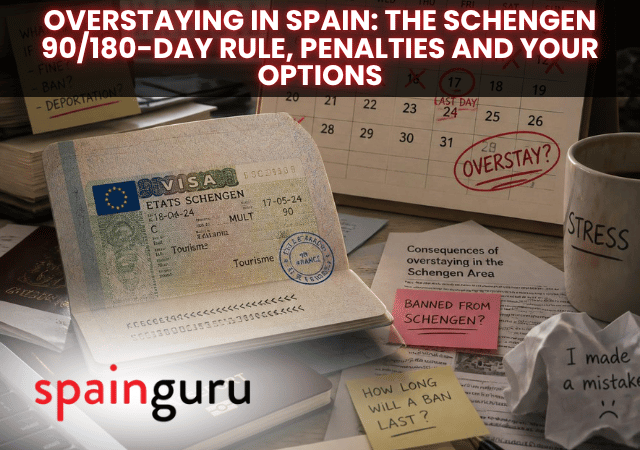
If you have ever counted days on your fingers before a flight home, you already know why overstaying in Spain worries so many travellers and future residents. Overstaying in Spain simply means staying beyond your authorised period. The rules are stricter, and far better enforced, than most visitors expect. This guide explains what counts as an overstay, the penalties you could face, and how it affects future visa or residency plans. It also covers your options if you have already stayed too long. Enforcement varies from case to case, so treat this as orientation, not a substitute for personalised legal advice.
Understanding the Schengen 90/180-day rule
Non-EU visa-exempt visitors and Schengen short-stay visa holders may stay up to 90 days within any rolling 180-day period. This limit covers the whole Schengen area, not each country separately.
Planning your move to Spain?
Get the free step-by-step roadmap used by 10,000+ expats — covering visas, budget, housing, and the mistakes to avoid.
Start the Moving to Spain Hub →
The 180-day window rolls forward every day. On any date, you look back over the previous 180 days and add up the days you spent inside Schengen.
Many people believe that leaving and re-entering resets the clock. It does not. A weekend in Morocco does not buy you fresh days, because the count always looks backwards.
A simple way to calculate your days
- Pick today’s date. Then count back 180 days.
- Add up every day you were physically inside the Schengen area in that window.
- Count both your entry day and your exit day as days of presence.
- If the total passes 90, you are overstaying in Spain or elsewhere in Schengen.
The European Commission offers a free short-stay calculator, and the official rules sit in the Schengen Borders Code on eur-lex.europa.eu. Run a calculator before you book return flights. It is the easiest way to stay safe.
What counts as overstaying in Spain
Overstaying in Spain covers two situations. The first is going past the 90/180 allowance as a tourist or short-stay visa holder.
Need an immigration lawyer?
Spainguru's vetted lawyers have helped 10,000+ expats with NLV, Digital Nomad, Student, and Golden Visa applications.
See Vetted Lawyers →The second is staying after a visa or residence permit expires, without renewing or regularising your status. In both cases, you remain in Spain without valid authorisation.
Under Spanish law, staying irregularly is an administrative infraction, not a crime. The governing framework is the Ley Organica 4/2000, known as the Ley de Extranjeria, published on boe.es.
The consequences of overstaying in Spain
Penalties range from a fine to, in serious or repeat cases, expulsion (expulsion) with a re-entry ban. The outcome depends on how officials classify the case and on your circumstances.
Fines can run broadly, from around 500 euros up to 10,000 euros, depending on the classification. An expulsion order usually adds a re-entry ban of one to five years, and longer in the most serious cases.
Crucially, Spain registers an entry ban as a Schengen-wide alert. That ban can therefore block your entry to every Schengen state, not just Spain.
Consequences at a glance
| Situation | Likely consequence |
|---|---|
| Minor first-time overstay of a few days | Often resolved with exit and/or a fine |
| Longer or repeated overstay | Higher fine; risk of expulsion |
| Serious or aggravated cases | Expulsion with a 1 to 5 year re-entry ban |
| Any recorded overstay | Possible harm to future visa and residency applications |
In practice, officials often resolve a minor first-time overstay with an exit and, at most, a fine. Outcomes still vary from one border officer, region, and case to the next.
How an overstay affects future visa and residency applications
Your immigration history follows you. A recorded overstay can weaken future Schengen visa applications, because consulates weigh your past compliance when they assess new requests.
It can also complicate longer-term plans, including the Spain Non-Lucrative Visa and the Spain Digital Nomad Visa. Consulates review your record, and a prior overstay is a red flag they may question.
This is a real risk, but not an automatic refusal. Many applicants with a minor past issue still succeed, especially with a clear explanation and strong documents. So plan your pathway carefully with the Spain visa navigator.
Why enforcement is tightening: EES and ETIAS
For years, officers tracked overstays through manual passport stamps and counted the days by hand. That era is ending.
The EU Entry/Exit System (EES) is a biometric border system that records entries and exits automatically. It began a phased rollout across the EU from October 2025. It makes overstays far easier to detect than the old stamps ever did.
A related pre-travel authorisation for visa-exempt travellers, ETIAS, is expected to follow. Both systems are still phasing in. The direction is clear, though: from now on, systems count your days automatically, and overstaying in Spain is much harder to hide.
Special situations that raise questions
Overstaying due to force majeure
Genuine emergencies happen. If a medical crisis or another force majeure event kept you in Spain past your allowance, document everything, such as hospital records and cancelled tickets.
Officials can treat these circumstances as mitigation, but they assess each case individually. Seek legal help before you travel, so you present your evidence properly.
Leaving through a Spanish airport after a short overstay
Travellers who overran a tourist period by a few days often worry about exit control at a Spanish airport. Border officers do have discretion, and a fine or a warning is possible.
Ignoring the situation is riskier than facing it. Officers usually treat a short, clearly accidental overstay far more leniently than a long or repeated one, especially when you are honest.
Waiting for a residence card (TIE) decision
Being mid-process on a lawful residence application differs legally from simply overstaying as a tourist. Applicants who await a TIE decision often sit within a recognised procedure rather than in irregular limbo.
Even so, the details matter enormously. Confirm your exact status with a lawyer before you assume you are protected, because timelines and paperwork decide everything.
Does owning property in Spain let you stay longer?
No. Buying a home in Spain is wonderful, but it does not change the 90/180 limit for non-residents in any way.
Property ownership grants no automatic right to stay beyond your authorised period. If you want more time, you need the correct visa or residence permit, not a title deed.
What to do if you have already overstayed
The worst response is to hope nobody notices, especially now that EES logs movements automatically. Take measured, informed action instead.
- Work out precisely how many days you have overstayed, using a Schengen calculator.
- Ask a qualified immigration lawyer for advice before you act or travel.
- Consider your exit route, and whether leaving voluntarily suits your case.
- Keep evidence of any mitigating circumstances, such as medical or travel disruption.
- Do not try to re-enter Schengen on a fresh 90 days if your count is already blown.
Here you can find Spainguru’s recommended services for Spanish visas: https://spainguru.es/services-for-spanish-visas/
Join Spainguru’s Spain Non Lucrative Visa Facebook group here: https://www.facebook.com/groups/spanishnlv
A professional can often help you regularise, explain a mitigating situation, or plan a future application, so a past mistake does not define your record. The community also shares real experiences that put the rules in context.
Conclusion
Overstaying in Spain is easy to do by accident, and increasingly hard to get away with. Yet it is rarely the end of your Spanish story. Understand the rolling 90/180 rule, count your days honestly, and act early if you have slipped over the line.
The penalties range from a modest fine to expulsion and a Schengen-wide ban. Still, officials often resolve minor first-time cases gently. With good advice and honest documents, most people protect their future plans and still build the life in Spain they came for.
This article is for informational purposes and reflects the experience of the Spainguru community alongside publicly available sources. It is not legal advice. For professional guidance, consult expert immigration lawyers — see https://spainguru.es/services-for-spanish-visas/.
Get your free step-by-step Spain move plan
10 emails over 2 weeks covering visas, budget, housing & the mistakes to avoid.
Join 10,000+ expats who used this roadmap.
100% free · No credit card · Unsubscribe anytime