Last Updated on July 8, 2026 by Bruno Bianchi
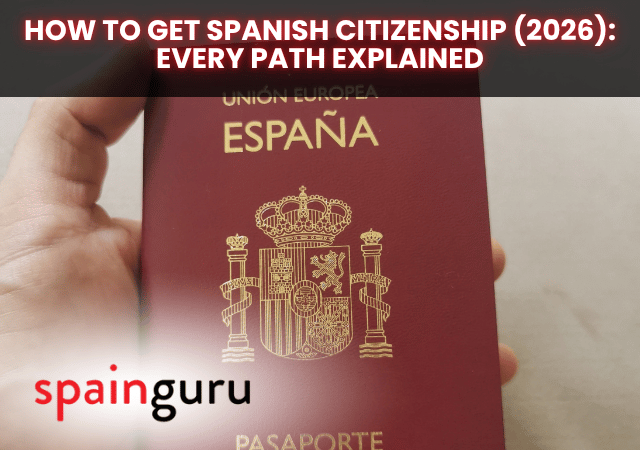
Spanish citizenship opens the door to an EU passport, visa-free travel across most of the world, and the right to live and work in any European Union member state. If you are weighing your options for 2026, the key thing to understand is that Spanish citizenship is not one process but four distinct legal routes, each with its own rules and timelines.
This guide explains every path to Spanish citizenship: by origin, by residence, by option, and by naturalization. You will learn how many years of residence each route requires, which exams you must pass, what documents you need, how much it costs, and whether you can keep your current passport. Here is how each route works and which one is likely to apply to you.
Planning your move to Spain?
Get the free step-by-step roadmap used by 10,000+ expats — covering visas, budget, housing, and the mistakes to avoid.
Start the Moving to Spain Hub →What Spanish citizenship really means: four legal routes
Under the Spanish Civil Code, nationality can be acquired in four legally distinct ways. Knowing which category you fall into is the first step, because the requirements change dramatically from one to the next.
- By origin (por origen): automatic nationality for children of a Spanish parent and certain people born in Spain. No residence period or exams.
- By residence (por residencia): the main naturalization route, based on living legally in Spain for a set number of years.
- By option (por opción): a simplified route for people with a specific legal link to Spain, such as being under the guardianship of a Spanish citizen.
- By carta de naturaleza: a discretionary grant awarded by the government in exceptional cases.
The official overview of how nationality is acquired is published by the Spanish administration on its public information portal. Below, each route is broken down in plain English.
Spanish citizenship by origin (por origen)
Citizenship by origin is the strongest form of Spanish nationality, and it usually involves no residence requirement at all. It passes through bloodline (jus sanguinis) rather than through time spent in the country.
Children of a Spanish parent
If at least one of your parents was a Spanish national at the time of your birth, you are Spanish by origin, regardless of where you were born. In practice you register the birth at the nearest Spanish consulate and provide certified proof of your parent’s nationality.
Looking for visa-compliant health insurance?
Get fully compliant, zero-waiting health insurance accepted by all Spanish consulates. Trusted by 150,000+ in our community.
Get a Free Quote →Because this route relies on documents from abroad, most foreign certificates must be apostilled and officially translated. Spainguru’s apostille guide and its directory of sworn translators registered with the Ministry of Foreign Affairs explain how to prepare these documents correctly.
Born in Spain and other origin cases
People born in Spain to foreign parents who themselves were born in Spain can also be Spanish by origin. The same applies to children born in Spain who would otherwise be stateless, and to certain cases of adoption by a Spanish national.
Spanish citizenship by residence: the most common route
For most expats, Spanish citizenship is earned through legal, continuous residence in Spain. This is the route that applies to anyone who moved to Spain on a visa and built a life there over several years.
How many years of residence you need
The required period depends on your nationality and personal situation:
- 10 years: the general rule for most nationalities, including citizens of the United States, the United Kingdom, and Canada.
- 5 years: for people who have been granted refugee status.
- 2 years: for nationals of Ibero-American countries, Andorra, Portugal, the Philippines, and Equatorial Guinea, as well as Sephardic Jews who can prove their heritage (2-year fast track)
- 1 year: for people born in Spain, those married to a Spanish citizen for at least one year, widows or widowers of Spaniards, and grandchildren of a Spaniard by origin, among other family cases.
Crucially, the residence must be legal and continuous, with absences generally not exceeding around three months per year, prior to application. Many applicants first build these years on a residence permit such as the Spain Non-Lucrative Visa, which is a common way to start the residence clock before qualifying for Spanish citizenship.
The DELE A2 and CCSE exams for Spanish citizenship
Most residence-based applicants must pass two tests administered by the Instituto Cervantes. The DELE A2 proves basic Spanish language ability, and the CCSE covers constitutional and sociocultural knowledge of Spain.
There is an important exemption: nationals of Ibero-American countries are exempt from the DELE A2 language exam, a change that has simplified the process for eligible applicants. The CCSE civics test still applies to almost everyone.
Documents, fees and processing time
The core application is filed electronically and includes your birth certificate, criminal record certificates from Spain and your country of origin, proof of legal residence, and your exam certificates. Foreign documents must be apostilled and translated by a sworn translator.
The government fee (Tasa 790, model 026) is currently 104.05 euros. Processing times in 2026 typically range from about 6 to 12 months for straightforward files and up to 1 to 2 years for more complex cases.
Spanish citizenship by option (por opción)
The option route is a simplified path for people with a particular legal connection to Spain rather than long residence. It is not open to everyone, but it is faster than naturalization for those who qualify.
Typical cases include people who are, or were, under the guardianship or custody of a Spanish citizen, and those whose mother or father was originally Spanish and born in Spain. The option must usually be exercised within a set time limit, which is why acting promptly matters for anyone who may be eligible.
Carta de naturaleza and the Democratic Memory Law
The carta de naturaleza is a discretionary grant of nationality, awarded by Royal Decree when the government recognizes exceptional circumstances. It has historically been used for special cases and for specific reparation laws.
What happened to the Grandchildren Law in 2026
The Democratic Memory Law, widely known as the Grandchildren Law or Ley de Nietos, allowed the descendants of Spaniards who fled exile or lost their nationality to claim citizenship. Its application window closed permanently on 21 October 2025, and the government confirmed there would be no further extension.
This means new applications under that law can no longer be submitted in 2026, although files lodged before the deadline continue to be processed. Spainguru covered the closing in detail in its report on the end of the Grandchildren Law, which explains what remaining options exist for descendants.
Dual nationality and Spanish citizenship
Whether you can keep your original passport is one of the most common questions about Spanish citizenship. As a general rule, applicants who naturalize by residence are asked to formally renounce their previous nationality when they swear allegiance.
However, there is a broad list of exemptions. Nationals of Ibero-American countries, Andorra, Portugal, the Philippines, Equatorial Guinea, France, and Sephardic Jews can keep their original nationality alongside Spanish citizenship.
For citizens of countries not on that list, such as the United States, the renunciation is a declaration made under Spanish law and is not always recognized by the country of origin, which creates a nuanced situation. This is a point where professional legal advice is genuinely valuable before you apply.
Common mistakes to avoid
The most frequent error is miscounting residence: holidays and long trips abroad can break the continuity that Spanish citizenship by residence requires. Keep careful records of your time in Spain.
Other common problems include letting criminal-record certificates or the medical and civil documents expire before filing, underestimating apostille and translation timelines, and assuming marriage to a Spaniard grants nationality automatically. It does not; it only shortens the residence requirement to one year.
Where to get help
Because the routes differ so much, many applicants benefit from a professional review of their eligibility before spending money on exams and translations. Here you can find Spainguru’s recommended services for Spanish visas and nationality: https://spainguru.es/services-for-spanish-visas/.
You can also compare notes with others going through the same process. Browse all Spainguru Facebook communities here: https://spainguru.es/spainguru-facebook-groups-and-spainguru-community/.
Bottom line
Spanish citizenship is within reach for far more people than they realize, but the right path depends entirely on your background. If you have a Spanish parent, the origin route may make you a citizen already; if you have lived in Spain for years, the residence route is your goal; and if you come from an Ibero-American country, the two-year fast track is a major advantage.
Whichever route fits, start by confirming your category and gathering apostilled, translated documents early. If you are planning your application for 2026, a short consultation with an immigration lawyer is the safest way to avoid a costly misstep on the road to Spanish citizenship.
This article is for informational purposes and reflects the experience of the Spainguru community alongside publicly available sources. It is not legal advice. For professional guidance, consult expert immigration lawyers — see https://spainguru.es/services-for-spanish-visas/.
Get your free step-by-step Spain move plan
10 emails over 2 weeks covering visas, budget, housing & the mistakes to avoid.
Join 10,000+ expats who used this roadmap.
100% free · No credit card · Unsubscribe anytime