Last Updated on September 18, 2026 by Bruno Bianchi
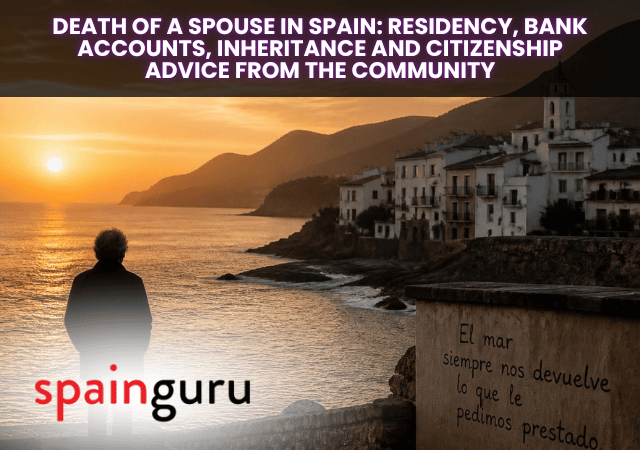
Few situations are harder to prepare for than the death of a spouse in Spain, especially when one partner is Spanish and the other is a foreign resident whose legal status depends on the marriage. Grief arrives together with a list of practical questions about residency, bank accounts, the will, funeral arrangements and pensions.
A member of the Spain Immigration and Residency Questions Facebook group, an American married to a Spanish citizen in Granada, recently asked the community what needs to be done before and after losing a spouse in Spain. The replies were unusually detailed and came from people who had been through the same process.
Planning your move to Spain?
Get the free step-by-step roadmap — covering visas, budget, housing, and the mistakes to avoid.
Start the Moving to Spain Hub →This article preserves the original question and the most useful answers, then organizes the community’s advice into a practical guide covering residency rights for the surviving spouse, joint bank accounts, wills and inheritance, funeral insurance, the widow’s pension and the fast track to Spanish citizenship.
The Original Question About the Death of a Spouse in Spain
“Does anyone have experience dealing with the death of a spouse here in Spain? My husband has terminal cancer and is now on palliative care. He’s Spanish and I’m American, and I’m feeling totally lost about what things need to be done both before I lose him as well as following his death.
Or who should I be talking to for advice? A lawyer, a gestor, a notary? We don’t own much together (we rent our house). We just own a car and our dogs.
He has signed a will, but that’s it so far. I only have a 5-year residency visa right now. I was planning to start the citizenship process in a few months, but now everything seems so precarious. If anyone could give me some practical advice, I’d really appreciate it. This is an exceptionally difficult time.”
Not sure which city is right for you?
Compare cost of living, weather, expat community size, and lifestyle across 33 Spanish cities with our free City Finder.
Find Your City →Death of a Spouse in Spain: Answers from the Community
“I’m so sorry for what you are going through. Most of bureaucratic things will be done behind the scenes by the government. You will need to take care of the funeral and things like that. Keep in mind the bank will freeze 50% of the money in the account as soon as they know about his passing, so plan for that and it will be months till it’s back open for you to use.
So opening an account just in your name so you can easily pay bills and things will be helpful. Changing ownership of the car to you now might be helpful as well. As for your residency, do not worry about it. Even if you haven’t been here long there is provision for widows of Spanish citizens to amend their residency to independent one.”
“Because of how Spain treats shared assets. They automatically freeze half of the account regardless who actually was putting money into it. And to get access to the rest of the money you have to go through the whole inheritance process.
While the car won’t be affected in the practical way as bank account, you would still have to go through inheritance process of however long it takes to get that sorted so if you can do it ahead of time saves you time and money, but more importantly allows you time to focus on important things and not small but annoying bureaucratic messes.”
“First have you had the will notorised? Second is it up to date and nothing major has changed since he made it? Do you also have a funeral plan in place? Things move quickly in Spain, so it’s always good to have something organised. Although if he’s Spanish I wonder if he may have funeral insurance instead, which is more common in the Spanish community.”
“One thing I forgot to mention is to make sure the executor named on the will is still able to deal with the probate on his estate themselves, or can get someone to help on their behalf. Seguro de descesos is effectively funeral insurance. When you are feeling up to it, it would be an idea to reach out to the company to ask for the current insured sum, capital asegurado, to make sure it will cover the cost of the funeral he wants.
You could also check the policy details to make sure everything has been registered correctly & he is named as a beneficiary etc. If he’s got seguro de decesos then you would use this in place of a funeral plan; most companies will have a network of funeral homes they work with so they can arrange everything for you.”
“I think if at all possible, you should open a simple bank account in your name only and transfer funds into it from your joint account, so that you can continue to pay bills and have money to live on. If you are able to, it might be an idea to try and get power of attorney in order to handle financial affairs on behalf of your husband and you.
A good solicitor can organise this and even arrange for the notary to come to your husband’s bedside to witness and notarise everything so it’s fully legally accepted.”
“My heart goes out to you. Positioning yourself with a reliable lawyer and gestor now, might be a good thing to consider. Having a team in place means one less thing to maneuver through at a difficult time.”
Death of a Spouse in Spain: Residency, Pension and Citizenship Advice
Two members who had lived through the loss of a Spanish spouse gave the most detailed answers on residency, the widow’s pension and the citizenship route.
“Your husband’s will should be duly registered. I think this is done via the registro civil where you live or via a notary. If you have a joint bank account or if your Spanish bank account is in his name and you’re merely an authorized user, it will likely be frozen upon his death and until various legal proceedings play out. So you should establish your own account now, and move over to it some funds from your joint / his account, so that you are able to pay bills etc during the first few months after his death.
If your husband contributed to social security then, after his death, you should be entitled to a widowhood pension (pensión de viudedad). That pension will also entitle you to healthcare coverage in the public system, if you don’t already have it; if you do already have public healthcare coverage, you may find that the pension changes your coverage slightly (eg, no co pays for prescriptions).
As the widow of a Spaniard, you can apply for Spanish citizenship after only one year of legal residency in Spain. You must present evidence that you were not separated legally or in fact (ie you were living together) when he died; generally this is done by showing you were both listed on the Padrón as residing at the same address. If you and your husband are not currently empadronados at the same address, I strongly encourage you to do this ASAP as not having the padrón as proof makes the process more complicated – though not impossible, despite what some lawyers will tell you; you can submit other forms of proof.”
“Your residence does not die with him: it survives as long as you were living in Spain before it happens. What can kill it is the clock. Six months to report the death to the immigration office, and six months to ask for the residence in your own name, which is a separate request and doesn’t happen by itself.
On nationality, someone above told you to start now. Worth knowing you don’t lose that door either way. A widow of a Spaniard qualifies on one year of legal residence, and unlike the route for spouses there’s no condition about how long the marriage lasted. It isn’t a race against his illness.
The pension is where the real trap sits. If the death comes from an illness he already had when you married, they also want the marriage to have lasted a year, or children in common, or time living together that added to the marriage comes to more than two years. If you married recently, start pulling together proof of the years before, joint padrón above all, while he can still confirm it.
As for who: the notary, now, for his will. Quick, cheap, and the one thing that has to happen while he can still sign. The estate and the pension can both wait, and a gestor handles most of that part.”
“I have been there two years ago. We had wills which has helped a lot as we has a property together and I had a separate bank account, ehich was also very useful. We had funeral insurance – so they organized everything for me and it was done so smoothly and empathetically, it was immensely useful. Take care of yourself as well, I hope you have friends or family who will look after you.”
Death of a Spouse in Spain: Your Residency Does Not Disappear
The most urgent worry in the original post was residency. The community was reassuring on this point: the death of a spouse in Spain does not automatically cancel the surviving partner’s right to live in the country. A foreign spouse of a Spanish citizen normally holds a residence card as a family member of an EU citizen, and Spanish immigration rules contain specific provisions that let the surviving family member keep a residence right in their own name after the death.
Under Royal Decree 240/2007, the death of the Spanish citizen does not affect the residence right of a family member who was already residing in Spain with them, and the rules expressly allow that residence to be kept in the survivor’s own name. The same rules oblige the family to communicate the death to the immigration authorities. One member with direct experience warned that in practice the notification and the request for residence in the widow’s or widower’s own name have to be handled actively and within limited time frames, so this is a task to delegate to a gestor or immigration lawyer early rather than discover late.
Several members also suggested keeping the residency file clean before the loss: renewing on time if a renewal is due, and making sure both spouses appear on the same padrón (municipal register). The padrón is the single document most often used to prove that the couple lived together, and it becomes central to both the residency and the citizenship applications. Spainguru’s overview of residency options in Spain explains how the family-member route compares with other permits.
Death of a Spouse in Spain: Bank Accounts, the Car and Power of Attorney
The advice repeated most often in the thread about the death of a spouse in Spain concerned money. When a Spanish bank learns that an account holder has died, it blocks the deceased’s share of any account, which in a joint account is usually treated as 50 percent, until the heirs complete the inheritance process and present the tax paperwork. Members described waiting months for those funds to be released.
The practical recommendation from several members was the same: open an account in the surviving spouse’s name alone before the death, and move enough money into it to cover rent, bills and daily living for several months. Anyone who is only an authorised user on a spouse’s account, rather than a co-holder, is in an even weaker position and should act sooner. Spainguru’s guide to bank accounts and money transfers in Spain covers how to open an account as a foreign resident.
The car was mentioned repeatedly too. A vehicle registered in the deceased’s name has to pass through the inheritance process before it can be sold or re-registered, so transferring ownership to the surviving spouse in advance avoids a slow bureaucratic step later. One member also raised the option of a notarised power of attorney, which a lawyer can arrange even at a hospital bedside, so that the healthy spouse can manage the couple’s financial affairs while the ill partner is still alive.
Death of a Spouse in Spain: The Will, the Notary and Inheritance
The original poster’s husband had already signed a will before a notary, which the community considered the single most important step. A Spanish notarial will is automatically registered with the central registry of last wills, so after the death the heirs obtain a certificate of last wills (certificado de últimas voluntades) that confirms which will applies. A handwritten will (testamento ológrafo) can also be valid, but it must be written entirely by hand and signed by the testator, and after the death it has to be authenticated and formalised before a notary within five years, which is why members recommended signing a notarial will instead.
Members advised checking that the will is up to date, that nothing major has changed since it was signed, and that any executor named in it is still able to act. Even in a modest estate, such as a rented home, a car and pets, an inheritance deed is needed to release the frozen bank funds and re-register the vehicle, and inheritance and gift tax must be declared within six months of the death.
For the who-to-call question, the thread reached a clear consensus: the notary now, while the spouse can still sign, and a lawyer or gestor afterwards for the estate, the tax filings and the pension. If you do not already have professionals in place, Spainguru’s directory of lawyers in Spain and its list of gestores and tax accountants are good starting points. Here you can find Spainguru’s recommended visa and relocation services: https://spainguru.es/services-for-spanish-visas/.
Funeral Insurance in Spain: Seguro de Decesos
Funerals after the death of a spouse in Spain move quickly, often within 24 to 48 hours, which is why several members urged the poster to have arrangements in place beforehand. It turned out that the husband’s parents had bought him a seguro de decesos years earlier, a type of funeral insurance that is very common in Spanish families and that most foreign residents have never heard of.
A seguro de decesos policy typically covers the funeral costs and, through the insurer’s network of funeral homes, handles most of the organisation for the family. The community’s advice was to contact the insurer in advance to confirm the insured sum (capital asegurado), check that the policy details are correct and understand what the policy covers, so that on the day the family can simply make one call. Members who had used this type of insurance described the experience as smooth and empathetic at a time when they could not have managed the logistics themselves.
Death of a Spouse in Spain: The Widow’s Pension (Pensión de Viudedad)
After the death of a spouse in Spain, if the deceased contributed to Spanish Social Security, the surviving spouse can usually claim a contributory widow’s or widower’s pension, the pensión de viudedad. Members pointed out a benefit that is easy to overlook: the pension also gives the recipient access to the public healthcare system as a beneficiary in their own right, and can reduce prescription co-payments. Spainguru’s guide to healthcare in Spain explains how public coverage works.
One experienced member flagged the condition that catches recent marriages. When the death results from a common illness that already existed before the wedding, Social Security requires either that the marriage lasted at least one year, that the couple had children in common, or that the period of cohabitation before the marriage plus the marriage itself adds up to more than two years. Couples in this situation should gather proof of their years together, above all a joint padrón, while both partners can still confirm the facts.
Death of a Spouse in Spain: Spanish Citizenship After One Year of Residence
The poster had planned to apply for Spanish nationality in a few months and feared that the death of a spouse in Spain would close that door. The community’s answer was that it does not. The Spanish Civil Code allows the widow or widower of a Spanish citizen to apply for nationality by residence after just one year of legal residence in Spain, the same reduced period that applies to spouses, provided the couple was not legally or de facto separated at the time of death.
Unlike the spouse route, which requires the applicant to still be married and not separated when applying, the widowhood route has no requirement about how long the marriage lasted. As one member put it, the citizenship application is not a race against the illness. The applicant still has to pass the DELE A2 Spanish language exam and the CCSE civic knowledge test, and must be able to prove the shared life, which is where the joint padrón becomes essential again.
Members suggested speaking to an immigration lawyer who is familiar with the widowhood provision that applies after the death of a spouse in Spain, since some professionals are less used to it than to the standard spouse route. The lawyer does not need to be based in the same province for a citizenship application, although for the inheritance side a local professional can be more practical.
Death of a Spouse in Spain: Conclusion
The community’s response to this post shows how much can be organised in advance to soften the administrative side of the death of a spouse in Spain. The priorities that emerged were clear: a notarised and up-to-date will, a bank account in the surviving spouse’s own name with funds to cover several months, the car registered to the survivor where possible, a joint padrón, and a lawyer and gestor identified before they are needed.
On the two biggest fears, residency and citizenship, the answers were reassuring. A surviving spouse who was already living in Spain keeps a right of residence in their own name, provided the death is reported to the authorities and the paperwork is handled on time, and the path to Spanish nationality after one year of residence remains open to widows and widowers of Spanish citizens.
Start planning your life in Spain with Spainguru’s Move to Spain Planning Hub, and explore Spainguru’s vetted service providers for legal help, health insurance and tax advice.
Join Spainguru’s Spain Immigration and Residency Questions Facebook group here: https://www.facebook.com/groups/americanexpatsinspain. For more community channels, visit the Spainguru Community Hub.
This article is based on personal opinions from the Spainguru community and is not legal advice. For guidance on your specific situation, consult one of the expert immigration lawyers listed at https://spainguru.es/services-for-spanish-visas/.
Death of a Spouse in Spain: FAQ
Do I lose my residency after the death of a spouse in Spain?
Not automatically. Under Royal Decree 240/2007, a foreign spouse who was already residing in Spain as a family member of a Spanish citizen keeps a residence right in their own name, but the family must communicate the death to the immigration authorities and the card is then renewed independently. A gestor or immigration lawyer can handle these steps.
Can the widow of a Spanish citizen apply for Spanish nationality?
Yes. The widow or widower of a Spaniard can apply for nationality by residence after one year of legal residence in Spain, as long as the couple was not separated legally or in fact at the time of death. The DELE A2 and CCSE exams still apply.
Will the bank freeze our joint account after the death of a spouse in Spain?
Spanish banks block the deceased’s share of an account, usually half of a joint account, until the inheritance is settled and the inheritance tax paperwork is presented. Community members recommend opening an account in your own name beforehand and keeping several months of expenses in it.
What is a seguro de decesos?
It is Spanish funeral insurance, very common among Spanish families. The policy covers funeral costs up to an insured sum and the insurer’s network of funeral homes usually organises the ceremony and paperwork for the family.
Am I entitled to a widow’s pension in Spain?
If your spouse contributed to Spanish Social Security, you can usually claim the pensión de viudedad, which also gives access to public healthcare. If the death results from an illness that existed before the marriage, additional conditions apply, such as a marriage of at least one year, children in common, or more than two years of combined cohabitation and marriage.
Who should I contact first: a lawyer, a gestor or a notary?
The community’s consensus was the notary first, to sign or update the will and, if needed, a power of attorney while the ill spouse can still sign. A lawyer and gestor can then handle the inheritance deed, the tax declarations, the residency application and the pension claim after the death.
Why is the padrón so important after the death of a spouse in Spain?
A joint padrón is the standard proof that the couple lived together at the same address. It supports the residency application, the citizenship application as a widow or widower, and the pension claim, so both spouses should be registered at the same address as early as possible.
Get your free step-by-step Spain move plan
10 emails over 2 weeks covering visas, budget, housing & the mistakes to avoid.
Free, from the team behind a community of 225,000+ expats.
100% free · No credit card · Unsubscribe anytime