Last Updated on May 19, 2026 by Bruno Bianchi
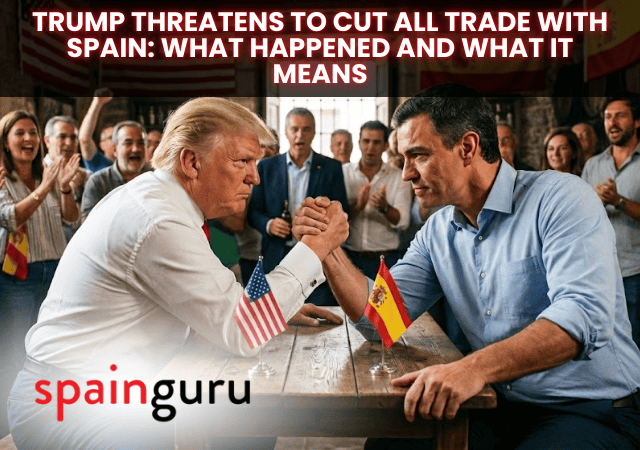
The relationship between Spain and the United States has entered one of its most turbulent chapters in recent memory. On Tuesday, March 3, 2026, President Donald Trump made a dramatic threat during a White House meeting with German Chancellor Friedrich Merz, declaring he would cut off all trade with Spain. For the expat community living in or planning to move to Spain, this escalating diplomatic standoff raises legitimate questions about Spain’s geopolitical standing, its economy, and its future role on the world stage. The Spainguru community, made up of thousands of Americans and international expats with direct stakes in Spain, has been following the story closely — and their reactions reveal a picture that is both informed and deeply personal.
Why Did Trump Threaten Spain?
Trump accused Spain of failing to meet NATO defense spending commitments and of refusing to allow U.S. forces to use Spanish bases to support operations related to strikes against Iran. (Fox Business) The backdrop is Operation Epic Fury, the joint U.S.-Israeli military campaign against Iran that launched over the weekend.
Planning your move to Spain?
Get the free step-by-step roadmap used by 10,000+ expats — covering visas, budget, housing, and the mistakes to avoid.
Start the Moving to Spain Hub →Spanish Prime Minister Pedro Sánchez condemned the strikes as a breach of international law, calling for dialogue and stating that one can oppose a hateful regime while still opposing an unjustified and dangerous military intervention. (Al Jazeera)
The day before Trump’s statement, Spanish Foreign Minister José Manuel Albares said Spain would not allow the U.S. to use jointly operated bases in southern Spain in any strikes not covered by the United Nations’ charter. (OPB / AP)
Trump said “Spain has been terrible” and directed Treasury Secretary Scott Bessent to “cut off all dealings” with the country. (Stars and Stripes) He also suggested, provocatively, that the U.S. could simply fly in and use the bases regardless of Spain’s position.
A well-informed community member in the Spainguru group broke down Spain’s legal standing clearly: the bilateral treaty between Spain and the United States, which dates back to the Reagan era, grants Spain sovereignty over how those bases are used in accordance with NATO and UN law. Since Spain considers this particular military campaign to be outside international legal frameworks — and since the U.S. did not reach consensus with NATO or the UN before launching strikes — Spain’s refusal is grounded in treaty rights, not a breach of alliance obligations.
Looking for visa-compliant health insurance?
Get fully compliant, zero-waiting health insurance accepted by all Spanish consulates. Trusted by 150,000+ in our community.
Get a Free Quote →Another member drew a sharp historical parallel, noting that Spain allowed the U.S. to use its bases during the Iraq War, and shortly afterward the Atocha train station in Madrid was bombed by terrorists. “I don’t blame them,” they wrote, capturing a sentiment shared by many in the community.
The Military Bases at the Center of the Dispute
The bases in question are Naval Station Rota and Morón Air Base, both in Andalusia. The United States maintains access to these installations under a long-standing bilateral agreement, but Spain retains sovereignty and must authorize any use beyond the scope of that agreement. Combat operations or offensive strikes launched from Spanish territory would generally require Madrid’s approval. (Fox Business)
Following Spain’s refusal, the U.S. relocated 15 aircraft, including refuelling tankers, from the two southern bases. (Al Jazeera)
The NATO Defense Spending Dispute
Trump also raised Spain’s refusal to back NATO’s 5% GDP defense spending target, calling Spain “the only country in NATO that would not agree to go up to 5%.” Spain indicated it could meet its military capabilities at 2.1% of GDP. German Chancellor Merz acknowledged Trump was correct on the spending figures and said Germany was “trying to convince” Spain that complying was part of their common security. (Main Line Media News / AP) The fact that a European leader sat beside Trump and validated this talking point while the trade threat was being issued did not go unnoticed in Madrid — or in the Spainguru community.
Can Trump Actually Cut Trade With Spain?
This is the question the community has debated most vigorously, and the consensus is remarkably consistent: legally, it is far more complicated than Trump’s declaration suggests.
It is unclear how Trump would cut off trade with Spain given that Spain is a member of the European Union, which negotiates trade agreements collectively on behalf of all 27 member states. (Fortune) As one community member put it bluntly: “The trade agreement is with the European Union, not with individual European countries.”
Trump argued he has broad executive authority to restrict trade without congressional approval, citing what he described as Supreme Court-affirmed powers. Treasury Secretary Bessent and U.S. Trade Representative Jamieson Greer said the administration could pursue investigations and take further action if Trump chooses to move forward. (Fox Business)
Community members pushed back strongly on this. Several pointed out that the U.S. Supreme Court recently struck down Trump’s sweeping global tariffs, ruling that the International Emergency Economic Powers Act does not authorize such unilateral action. Trump’s team has argued that the same ruling paradoxically affirms embargo powers — a reading many legal observers and community members described as a stretch.
One member who runs a transatlantic law firm with offices in Spain, Portugal, and the U.S. offered a particularly grounded perspective. “I do not think the U.S. will cut off trade with Spain. The economic relationship between the two countries is simply too significant,” they wrote. “But businesses do not wait for political clarity. Even the perception of instability can drive decisions. We’ve already had calls from clients talking about shifting more of their European operations to Portugal, simply to hedge against political risk. Whether that proves necessary is another question, but in international business, companies tend to move early when politics introduces uncertainty.”
The Trade Numbers Tell Their Own Story
Several community members went beyond the political noise and looked at the actual data — and it does not favor Trump’s position.
One member noted that U.S. exports to Spain run between $26 and $27.8 billion, while Spain exports $20.5 to $21.3 billion to the United States, meaning the U.S. actually holds a trade surplus with Spain. Cutting trade would likely hurt the American side more. Another member confirmed that Spain sends less than 5% of its exports to the U.S., meaning other partners could absorb much of the gap. A third pointed out that Spain is the world’s top exporter of olive oil, and also sells auto parts, steel, and chemicals to the U.S. — products with real American consumers on the receiving end.
One community member summed it up succinctly: “The U.S. has a trade surplus with Spain for the fourth year in a row. Cutting trade ties would likely have a larger impact on the U.S. economy.”
Spain’s Response: Firm and Defiant
Madrid called on Washington to respect international law and the bilateral trade agreements between the EU and the U.S., stating it had “the necessary resources to contain possible impacts, help sectors that may be affected, and diversify supply chains.” (Times of Israel / AFP)
Prime Minister Sánchez made clear he would not yield to the threats. (Bloomberg) He described the escalating Middle East conflict as a “disaster” and said it was naïve to believe that democracy could spring from ruins, or that blind obedience was a form of leadership. (CNBC)
One community member suggested Spain could follow the model of Canada’s Prime Minister Mark Carney, who responded to U.S. pressure by diversifying trade partnerships. “It’s working well for Canada,” they wrote.
International Reactions: Unexpected Allies
The European Commission announced it would defend the EU’s trade interests in response to Trump’s threats. (Euronews) France’s Macron also expressed full solidarity with Sánchez.
China came out publicly in Spain’s defense on Wednesday, rejecting the weaponization of international trade as political leverage. On social media, users around the world flooded Spanish accounts with support. “Spain is the moral compass in the EU” became a widely shared phrase internationally.
Spain’s IBEX 35 index actually traded higher in the days following the threat, reversing initial losses (CNBC) — a market signal that investors are not, for now, treating the threat as credible.
What the Expat Community Is Actually Feeling
Perhaps the most telling thread running through the Spainguru community discussion is not analysis but sentiment. Several members said Trump’s hostility toward Spain had, if anything, reinforced their decision to move there. “My wife and I plan to retire in Spain this coming fall. The fact that Trump now hates Spain just confirms we’re making the right decision,” wrote one member. Another, already living in Spain, said simply: “I’m more proud of my adopted home than the old one right now.”
One member offered what many in the group seemed to feel: “We allowed a rich man who is not used to people telling him no to be president. Now he throws a tantrum every time he is told no, and we all pay the consequences.”
One practical voice reminded the group that while political noise is loud, the real question is whether any of this reaches their daily lives. One member who monitors energy markets flagged LNG dependency as Spain’s sharpest short-term vulnerability if a real embargo were ever to materialize, and suggested Spain would need to move fast on energy supply diversification. But most members agreed with the broader sentiment that the threat, as stated, is likely more political theater than executable policy.
What This Means for Expats in Spain
For Americans living in Spain or planning a move, the key takeaways from both the news and the community discussion are consistent. A full trade severance with Spain is legally and practically extremely difficult given Spain’s EU membership and the collective trade framework. The U.S. actually benefits from the current trade relationship. Spain’s government has shown no sign of yielding. And the international community — from France to the EU Commission to China — has rallied behind Spain’s position.
The broader geopolitical picture is one of a Spain that has carved out an independent, principled foreign policy stance and, in doing so, has earned significant goodwill across Europe and beyond. For those building a life here, that is not an insignificant thing.
This article draws on international reporting and contributions from the Spainguru community. It does not constitute legal or financial advice. For questions about how geopolitical developments may affect your visa, residency, or relocation plans in Spain, consider consulting a qualified legal expert.
Get your free step-by-step Spain move plan
10 emails over 2 weeks covering visas, budget, housing & the mistakes to avoid.
Join 10,000+ expats who used this roadmap.
100% free · No credit card · Unsubscribe anytime