Last Updated on September 8, 2026 by Bruno Bianchi
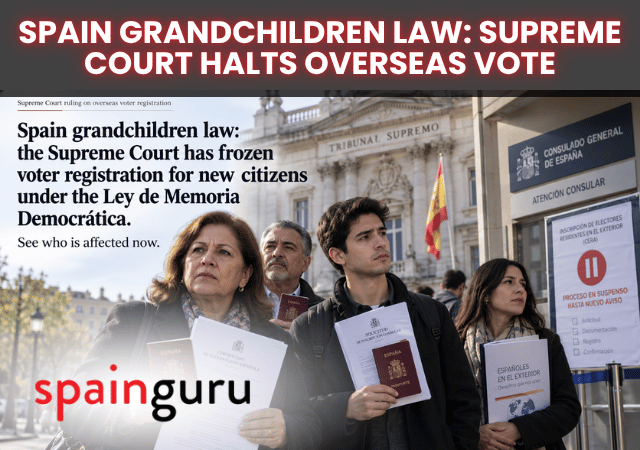
On 8 September 2026 Spain’s Supreme Court dealt a major setback to the Spain grandchildren law, the popular name for the nationality route created by the Ley de Memoria Democrática. The court provisionally suspended the registration of new Spanish citizens who obtained nationality through this route in the overseas electoral census, and froze the voting rights of those already registered.
In this article you will learn exactly what the Supreme Court decided, who is affected, what the ruling does not change (your nationality, passport or pending file), and what happens next. Let’s start with the decision itself.
Planning your move to Spain?
Get the free step-by-step roadmap — covering visas, budget, housing, and the mistakes to avoid.
Start the Moving to Spain Hub →What the Supreme Court decided on the Spain grandchildren law
The Contentious-Administrative Chamber (Sala Tercera) of the Tribunal Supremo partially granted the precautionary measures (medidas cautelares) requested by the association Iustitia Europa (case 1013/2026) and the political party Vox (case 1015/2026). According to El Español, the chamber adopted the measures by five votes to one after a public hearing held the day before.
Both appeals target a resolution of the Junta Electoral Central (JEC) of 16 July 2026. In that resolution the JEC concluded it had no power to refuse the inscription in the census, or the postal vote, of people who had become Spanish under the eighth additional provision of Law 20/2022, the Democratic Memory Law.
The three measures ordered by the court
The court’s order, as reported by Infobae and El Debate, has three parts:
- Pending files: nationality applications still being processed under the Spain grandchildren law continue their course, but the inscription in the Censo Electoral de Residentes Ausentes (CERA) is suspended once the file is completed, until the court issues its final judgment.
- Citizens already in the CERA: they remain registered, but the electoral effects of that registration are suspended, meaning they cannot vote from abroad in elections held while the measure is in force.
- The exile exception: the suspension does not apply to anyone whose consular civil registrar certifies that their parent or grandparent was originally Spanish, left Spain for political, ideological or religious reasons and lost or renounced Spanish nationality as a result.
The court also instructed the JEC to immediately require consular civil registrars to certify which cases meet the exile requirement. The Oficina del Censo Electoral must separate files that applied the law directly from those that relied on the broader government interpretation, and report on how new voters are being assigned to Spanish provinces.
Looking for visa-compliant health insurance?
Compare visa-compliant health insurance with no co-payments or waiting periods, built for Spanish visa applications.
Get a Free Quote →Why the Spain grandchildren law ended up in court
The dispute is not about whether descendants of Spaniards can become citizens. It is about how the government interpreted the word “exile” and about the electoral consequences of that interpretation.
What the Democratic Memory Law actually says
The eighth additional provision of Law 20/2022 of 19 October, the Ley de Memoria Democrática, granted a right of option to Spanish nationality to people born outside Spain whose father, mother, grandfather or grandmother was originally Spanish and lost or renounced their nationality as a consequence of exile for political, ideological or religious reasons, or for reasons of sexual orientation and identity. It also covered children of women who lost nationality by marrying a foreigner before 1978, and adult children of people who recovered nationality under earlier laws.
Spainguru’s community has followed this route since it opened. You can read the full background in our Ley de Nietos (grandchildren’s law) guide.
The 2022 Instruction that presumed exile
Days after the law entered into force, the Dirección General de Seguridad Jurídica y Fe Pública issued an Instruction dated 25 October 2022 to guide consulates. That Instruction presumed that every Spaniard who left Spain between 18 July 1936 and 31 December 1955 was an exile. Applicants only had to prove the departure, not the political motive behind it.
Iustitia Europa and Vox argue that this presumption went beyond the text of the law and turned a narrowly drawn reparation measure into a mass nationality programme. The Supreme Court has not yet ruled on that argument; the precautionary measures simply freeze the electoral effects while the case is decided.
Who is affected by the Spain grandchildren law ruling
The numbers explain why the case attracted so much attention. According to figures cited by EFE via Infobae, around 2.4 million people applied for Spanish nationality under the Spain grandchildren law before the window closed, 544,722 applications had been approved and roughly 306,000 people were already inscribed as Spanish nationals.
Most applicants live in Latin America, with Cuba, Mexico and Argentina consistently at the top of the list. Because new citizens who live abroad are registered in the CERA and assigned to a Spanish province, critics claimed the route could shift the result in several constituencies. Supporters of the law reject that reading and point out that voting is a right that follows automatically from nationality.
Applicants with a pending file
If your application is still being processed at a consulate, nothing changes in the nationality procedure itself. Consulates continue to resolve files, and the enormous backlog described in our article on the Democratic Memory Law nationality backlog remains the main obstacle. What is suspended is only the automatic step from nationality to the electoral census.
New Spanish citizens already registered in the CERA
If you are already inscribed as a Spanish citizen and appear in the CERA, you keep your nationality, your passport and your civil registry entry. Your ability to vote from abroad is suspended until the Supreme Court issues its final judgment, unless the consular registrar certifies that your ancestor’s departure qualifies as exile under the strict wording of the law.
Descendants of documented exiles
People who can document that a parent or grandparent was persecuted or forced to leave Spain for political, ideological or religious reasons fall under the exception. Their electoral rights are unaffected, provided the consular civil registry certifies the case without relying on the 1936-1955 presumption.
What the Spain grandchildren law ruling does not do
Much of the coverage on social media has been alarmist, so it is worth being precise. As eldiario.es and other outlets note, the Supreme Court has not annulled the Democratic Memory Law, and it has not revoked any nationality.
The ruling does not cancel Spanish passports or DNIs already issued. It does not stop consulates from resolving pending files. It does not reopen the application window, which closed on 22 October 2025, as we explained in our article on the end of Spain’s grandchildren law. And it does not affect any other route to Spanish citizenship, such as residence, marriage or the Sephardic law.
In short, this is a dispute about the electoral census, not about who is Spanish. For an overview of every path to nationality currently available, see our guide to Spanish citizenship in 2026.
Reactions to the Supreme Court decision
The Spanish government opposed the measures in court. The Abogacía del Estado asked for the appeals to be declared inadmissible and questioned how citizens whose nationality had been granted through a final administrative act could be deprived of a constitutional right. The Public Prosecutor argued that the appeals turned the electoral authorities into reviewers of nationality decisions, which is not their role.
After the decision, government spokesperson Elma Saiz said the ruling ran contrary to the criteria of both the Executive and the Junta Electoral Central, according to Euronews. Vox and Iustitia Europa celebrated the order, arguing that once an election is held the damage of an irregular census would be irreversible.
What happens next with the Spain grandchildren law
The precautionary measures stay in place until the Supreme Court rules on the merits of the two appeals. That final judgment will decide whether the 2022 Instruction, and the JEC’s decision to register these new citizens without further checks, were lawful.
In the meantime, consulates will be asked to certify exile cases individually, and the Oficina del Censo Electoral must reorganise how new citizens abroad are assigned to provinces. Expect delays and a great deal of confusion at consulates, which were already struggling with the volume of files. If you have a pending file, keep monitoring communications from your consulate and keep copies of any evidence of your ancestor’s exile, since that documentation may now matter for your voting rights.
Where to get help with the Spain grandchildren law
If you need professional advice on your nationality file, on documenting exile, or on any other Spanish immigration question, here you can find Spainguru’s recommended services for Spanish visas and nationality: https://spainguru.es/services-for-spanish-visas/
To follow how this case evolves and share your own experience with other applicants, browse all Spainguru Facebook communities: https://spainguru.es/spainguru-facebook-groups-and-spainguru-community/
Conclusion
The Supreme Court’s precautionary measures are a political and legal setback for the government, but their practical scope is narrower than many headlines suggest. Nationality granted under the Spain grandchildren law remains valid, pending files keep moving, and the only right that is frozen is the vote from abroad for those who cannot document a political exile.
The final judgment on the 2022 Instruction will be the moment that really matters, both for hundreds of thousands of new Spaniards and for the future design of citizenship by descent in Spain. Spainguru will update this article as the case develops.
This article is for informational purposes and reflects the experience of the Spainguru community alongside publicly available sources. It is not legal advice. For professional guidance, consult expert immigration lawyers, see https://spainguru.es/services-for-spanish-visas/.
Get your free step-by-step Spain move plan
10 emails over 2 weeks covering visas, budget, housing & the mistakes to avoid.
Free, from the team behind a community of 225,000+ expats.
100% free · No credit card · Unsubscribe anytime