Last Updated on June 7, 2026 by Bruno Bianchi
The number of Americans living in Spain has reached a record high, and it keeps climbing. Spain’s official statistics now count more U.S. citizens than at any point on record, driven by new visa routes and a wave of interest since 2022.
In this guide you’ll learn exactly how many Americans living in Spain there are according to two official sources, how fast the community has grown, why the two headline numbers differ, and which regions attract the most U.S. movers. Let’s start with the latest official figures.
Planning your move to Spain?
Get the free step-by-step roadmap used by 10,000+ expats — covering visas, budget, housing, and the mistakes to avoid.
Start the Moving to Spain Hub →How many Americans are living in Spain?
Two official Spanish bodies track this, and they produce slightly different numbers because they measure different things.
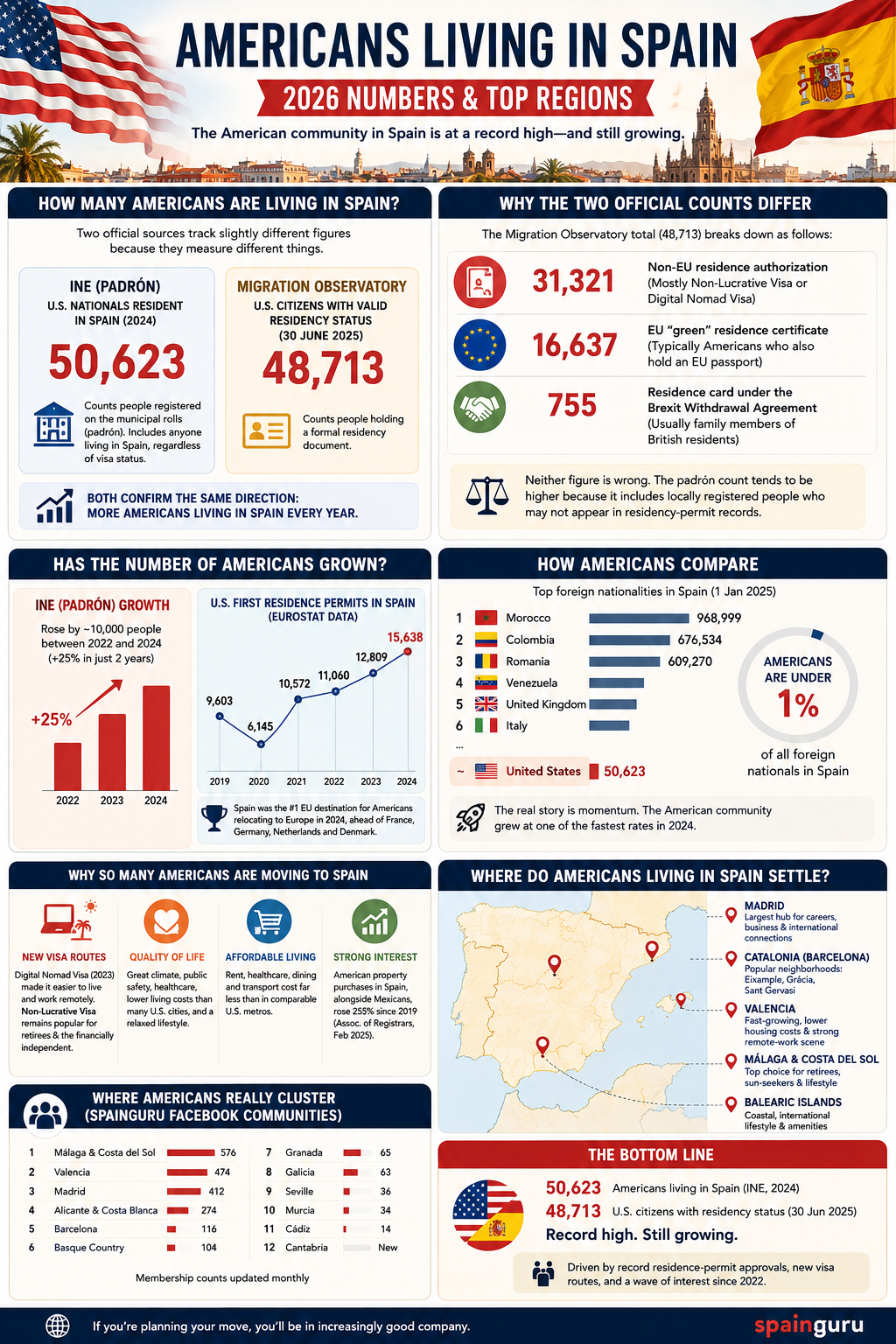
Spain’s National Statistics Institute (Instituto Nacional de Estadística, INE) recorded 50,623 U.S. nationals resident in Spain in 2024, the most recent figure in its official population series.
Spain’s Migration Observatory (Observatorio Permanente de la Inmigración), part of the Ministry of Inclusion, counted 48,713 U.S. citizens with valid residency status as of 30 June 2025. Both confirm the same direction of travel: more Americans living in Spain every year.
Why the two official counts differ
The INE counts people registered on the municipal rolls, known as the padrón. Anyone living in Spain is expected to register at their town hall regardless of visa status, so the padrón captures a broad picture of who actually lives in the country.
Looking for visa-compliant health insurance?
Get fully compliant, zero-waiting health insurance accepted by all Spanish consulates. Trusted by 150,000+ in our community.
Get a Free Quote →The Migration Observatory instead counts people holding a formal residency document. Its mid-2025 total breaks down as follows:
- 31,321 with a non-EU residence authorization, most obtained through visas such as the Non-Lucrative Visa or the Digital Nomad Visa.
- 16,637 with an EU “green” residence certificate, typically Americans who also hold an EU passport.
- 755 with a residence card under the Brexit Withdrawal Agreement, usually family members of British residents.
Neither figure is wrong. The padrón count tends to run higher because it includes people who are locally registered but may not appear in residency-permit records. For a relocation guide, citing both is the most honest approach.
Has the number of Americans living in Spain grown?
Yes, sharply and consistently. According to the INE, the number of Americans living in Spain rose by roughly 10,000 people between 2022 and 2024, an increase of about 25% in just two years.
The trend is even clearer in residency permits. According to Eurostat data on first residence permits issued to U.S. citizens, the climb has been almost unbroken:
- 2019: 9,603 first permits
- 2020: 6,145 (pandemic dip)
- 2021: 10,572
- 2022: 11,060
- 2023: 12,809
- 2024: 15,638 (record)
The 2024 total of 15,638 is the highest ever, 2,829 more than the year before. It also made Spain the number-one destination in the European Union for Americans relocating to Europe in 2024, ahead of France (13,062), Germany (8,507), the Netherlands (6,732), and Denmark (5,183).
This growth fits a wider pattern. On 1 January 2026, Spain’s total population hit a record 49,570,725, and for the first time more than 10 million residents were born abroad. The rise in Americans is one strand of a broader expansion in Spain’s international population.
How Americans compare with other foreign nationalities in Spain
Americans living in Spain are a fast-growing but still relatively small group within the country’s foreign population. On 1 January 2025, Spain was home to 6,911,971 residents with foreign nationality, about 14.1% of the total population.
The largest national groups dwarf the American community. According to the INE, the biggest foreign nationalities at the start of 2025 were:
- Morocco — 968,999
- Colombia — 676,534
- Romania — 609,270
- Venezuela, the United Kingdom, and Italy — other large, long-established communities
By comparison, the roughly 50,623 Americans counted by the INE represent under 1% of all foreign nationals in Spain. That places the U.S. community well outside the top 20 nationalities, and the single largest group, Moroccans, is nearly 20 times bigger.
The real story is momentum, not size. While some long-established groups such as British (-2.2%) and Bulgarian residents shrank in 2024, the American community grew at one of the fastest rates of any nationality, alongside Latin American groups like Colombia, Venezuela, and Peru.
Why so many Americans are moving to Spain
Several factors line up at once. The Spanish Digital Nomad Visa, introduced in 2023, made it far easier for working-age, non-EU professionals to live in Spain while working remotely. You can read how it works in Spainguru’s Digital Nomad Visa guide.
The Non-Lucrative Visa remains a popular route for retirees and the financially independent; the full process is covered in Spainguru’s Non-Lucrative Visa guide. Quality of life, public safety, healthcare, climate, and lower living costs than many U.S. metros all feature heavily in why Americans make the move.
The interest shows up in the property market too: a February 2025 report from Spain’s Association of Registrars found that purchases by Americans, alongside Mexicans, had risen 255% since 2019.
Cost of living is part of the appeal
For many U.S. movers, the math is a major draw. Rent, healthcare, dining, and transport in most Spanish cities cost a fraction of what they do in comparable American metros, even after recent increases in hotspots like Madrid and the islands.
That gap lets retirees stretch fixed incomes further and lets remote workers keep a U.S. salary while spending in euros. For a realistic breakdown of monthly budgets by city, see Spainguru’s cost of living in Spain guide. Analysts also link the recent acceleration to the 2023 launch of the Digital Nomad Visa and to heightened U.S. interest in relocating abroad through 2024 and into 2025.
Where do Americans living in Spain settle?
Americans cluster in a handful of regions that combine international connectivity, established expat networks, and lifestyle appeal.
- Madrid — the largest hub, anchored by multinationals, international schools, and embassy-linked networks. Best for those prioritizing career and business access.
- Catalonia (Barcelona) — Americans concentrate in neighborhoods such as Eixample, Gràcia, and Sant Gervasi.
- Valencian Community (Valencia) — one of the fastest-growing destinations, helped by lower housing costs and a strong remote-work scene.
- Andalusia, especially Málaga and the Costa del Sol — a major draw for retirees and sun-seekers, and a consistently strong cluster within the Spainguru community.
- Balearic Islands — popular for a coastal, high-amenity lifestyle.
To compare specific cities and regions in more depth, browse Spainguru’s Spain destinations guides.
Where Americans really cluster: Spainguru’s community data
Beyond the official statistics, Spainguru tracks where Americans actually gather through its network of local Facebook communities, with membership counts updated every month. The latest snapshot of Spainguru’s 12 local groups closely mirrors the official regional pattern:
- Málaga & Costa del Sol — 576 members
- Valencia — 474 members
- Madrid — 412 members
- Alicante & Costa Blanca — 274 members
- Barcelona — 116 members
- Basque Country — 104 members
- Granada — 65 members
- Galicia — 63 members
- Seville — 36 members
- Murcia — 34 members
- Cádiz — 14 members
- Cantabria — newest and growing
You can explore the live, monthly-updated breakdown on Spainguru’s Where are Americans living in Spain page.
Wherever you are headed, there is probably a community waiting for you. Find and join your local group through Spainguru’s Facebook groups and community hub, and connect with future neighbors before you even arrive.
What this means if you are planning your move
A larger, faster-growing community of Americans living in Spain brings practical benefits: bigger peer networks, more shared know-how on visas, taxes, housing, and schooling, and stronger support ecosystems in the most popular areas. It also signals that Americans increasingly treat Spain as a long-term home rather than a short experiment.
If you are at the planning stage, start with Spainguru’s Moving to Spain guide. Here you can find Spainguru’s recommended services for Spanish visas: https://spainguru.es/services-for-spanish-visas/.
Join Spainguru’s Spain Non Lucrative Visa Facebook group here: https://www.facebook.com/groups/spanishnlv.
Bottom line
The latest official INE figure for Americans living in Spain is 50,623 (2024), while Spain’s Migration Observatory counts 48,713 U.S. citizens with residency status as of mid-2025. You can review the headline population data directly in the INE’s January 2026 population release.
Both sources confirm the same thing: the American community in Spain is at a record high and still growing, driven by record residence-permit approvals and accessible new visa routes. If you are weighing a move in 2026, the data suggests you will be in increasingly good company.
This article is for informational purposes and reflects the experience of the Spainguru community alongside publicly available sources. It is not legal advice. For professional guidance, consult expert immigration lawyers — see https://spainguru.es/services-for-spanish-visas/.
Get your free step-by-step Spain move plan
10 emails over 2 weeks covering visas, budget, housing & the mistakes to avoid.
Join 10,000+ expats who used this roadmap.
100% free · No credit card · Unsubscribe anytime