Last Updated on May 19, 2026 by Bruno Bianchi
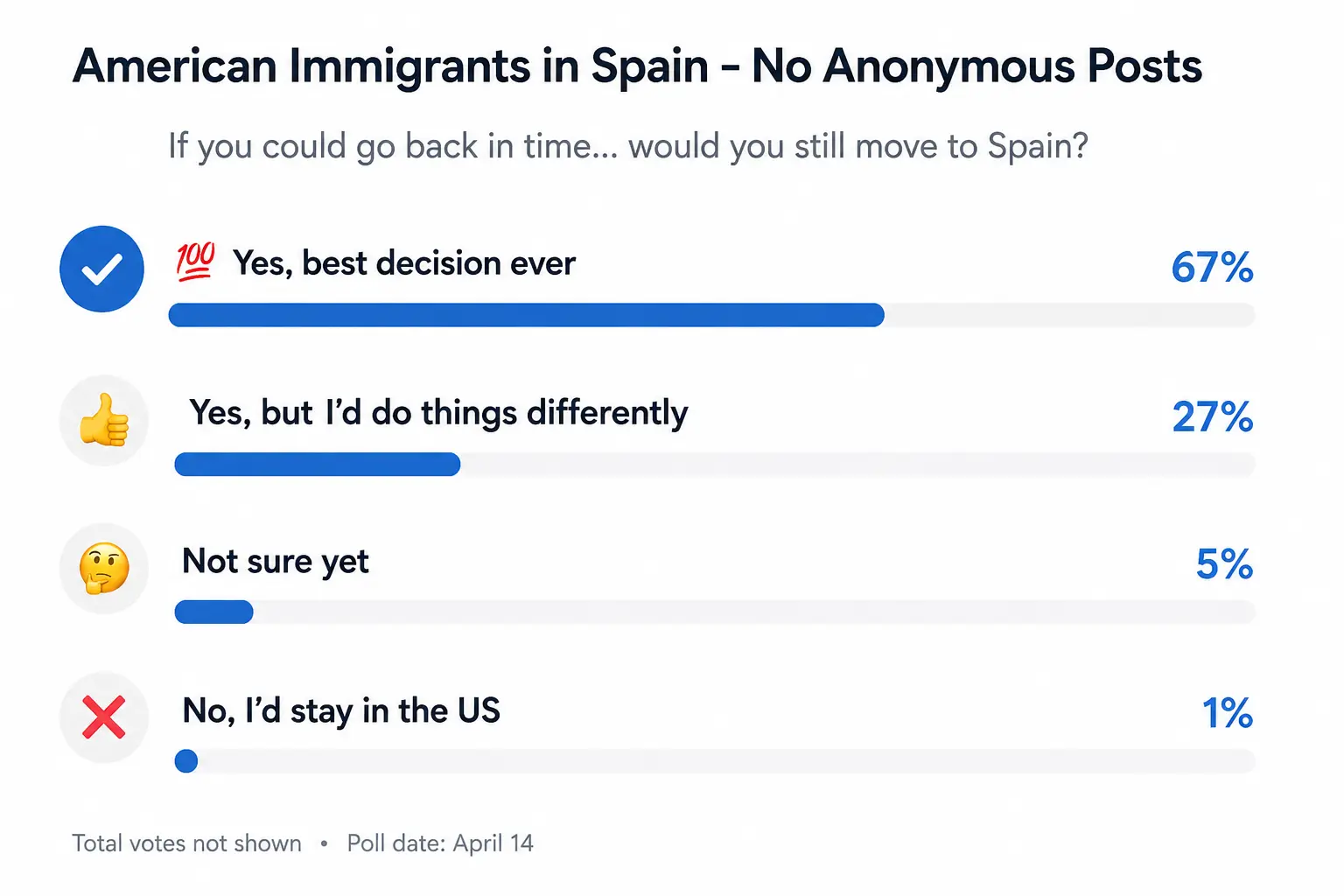
Moving to Spain mistakes are easier to spot in hindsight than in the planning phase. A recent Spainguru community poll asked 63 community members whether they would still move to Spain if they could go back in time. The breakdown surfaced a useful question: what would they actually change?
Of the 63 respondents, 67 percent said it was their best decision ever. Another 27 percent said yes, but they would do things differently. Five percent were not sure yet. Only 1 percent said they would have stayed in the US. The follow-up thread asked the “yes, but differently” voters to share what they would change. The answers below pull together those lessons into a single guide on the most common moving to Spain mistakes.
Planning your move to Spain?
Get the free step-by-step roadmap used by 10,000+ expats — covering visas, budget, housing, and the mistakes to avoid.
Start the Moving to Spain Hub →Poll Results: How Many Community Members Would Still Move to Spain?
The poll asked a simple question with four options. The results across 63 votes:
- 67% — Yes, best decision ever
- 27% — Yes, but I would do things differently
- 5% — Not sure yet
- 1% — No, I would stay in the US
The pattern is striking. Almost everyone would still move. The headline insight is in the 27 percent group — the people who love being in Spain but learned the hard way. Their lessons are the most useful guide to avoiding moving to Spain mistakes.
Moving to Spain Mistakes: The Visa Path Decision
Several respondents said they would have chosen a different visa path. The most common rethink: the Non-Lucrative Visa is the default for many US applicants, but it is not always the best fit.
“In my case, not bothered with an NLV and instead done the pareja de hecho with my EU citizen partner right away. It was a much easier process.”
Looking for visa-compliant health insurance?
Get fully compliant, zero-waiting health insurance accepted by all Spanish consulates. Trusted by 150,000+ in our community.
Get a Free Quote →For people with an EU-citizen partner, the family-route visa is often faster and simpler than the NLV. For applicants without that option, the choice between NLV, Digital Nomad Visa, Student Visa, and Golden Visa depends on income source, work plans, and budget. The Spain Visa Navigator walks through the comparison.
Moving to Spain Mistakes: Hiring the Wrong Help
Hiring help is one of the higher-leverage decisions in the move. Hiring the wrong help is one of the most expensive moving to Spain mistakes.
“I would not have hired a lawyer. It cost us money to pay her but also listening to her bad advice. But most importantly it cost us time and delayed our application 4 months.”
“We hired a gestor. But it’s a British firm. I would suggest hiring a Spanish firm with English-speaking staff.”
“I would hire a gestor to help with all the paperwork.”
The pattern: a gestor or immigration lawyer is often worth the cost, but quality matters more than fee. Choose a firm with deep Spanish-system knowledge plus enough English to communicate clearly. The Spainguru directory of immigration lawyers and the gestores directory list practitioners with track records.
Moving to Spain Mistakes: Tax Planning Too Late
The most consistent regret across the thread was failing to do tax planning before arriving. Spanish tax obligations begin once tax residency triggers — typically by spending more than 183 days in Spain in a calendar year. Decisions about asset structure, retirement accounts, real estate sales, and business ownership are far easier to make before that switch flips than after.
“Finances FIRST. Get a tax analysis before you move.”
“It shouldn’t be a surprise to anyone how high Spanish taxes are and I was well informed (since I did an analysis via a trusted CPA based in Germany who is an expert on Spain). However I think many people are misinformed about their Social Security and think it won’t be taxed and then they are super sad.”
“We met (and paid) with two different tax lawyers in Spain while working our NLV process and found that neither of them fully understood the US Expat tax laws for Spain in general or the Province we would be living in.”
For a framework on Spanish tax for international residents in Spain, see the Spainguru taxes guide for Spain residents. For US-Spain dual-filing specialists, the US-Spain tax preparers directory lists vetted practitioners.
Moving to Spain Mistakes: Currency Exchange Timing
One respondent flagged a financial cost that few new arrivals plan for: timing the conversion of US dollars to euros.
“I would have made different financial decisions like transferring my money over when the USD was equal to the euro instead of the terrible rates I got.”
The lesson is not to time the market. The lesson is to spread transfers over time and use a competitive transfer service rather than the bank. Wise, Revolut, Payoneer, and similar services offer mid-market rates that beat traditional bank wire fees by significant margins. The Spainguru bank accounts and money transfer guide covers the major options.
Moving to Spain Mistakes: The Driver’s License Window
Multiple respondents flagged the Spanish driver’s license process. The US does not currently have a license-exchange agreement with Spain, so US license holders must take the Spanish driving exam. The catch: the official six-month window starts when residency starts, and the autoescuela process takes longer than most people expect.
“Not exchanging my US DL for a Spanish one during the 6-month window. It was during COVID so everything was shut down. Now I have to go through the whole autoescuela nonsense.”
“We would have started the Spanish driving license process as soon as we arrived. It takes longer than we thought, including requesting and mailing apostilles from the US.”
For an overview of license exchange and autoescuela options by country, the Spainguru driving in Spain guide covers the current state.
Moving to Spain Mistakes: NIE Timing and Paperwork
Several respondents flagged the NIE process. Many new arrivals discover that they cannot sign certain contracts — long-term leases, fiber internet, certain phone plans — without the NIE in hand.
“Wish I had gotten my NIE before I arrived. Our legal rep has it listed with my Residency. So I am here 5 months without it.”
The procedural reality: getting a NIE before arrival is harder than many people assume, because the NIE is typically tied to a Spanish address. Some practitioners handle pre-arrival NIE requests via consulate channels. Others require an existing rental contract. The work-around for new arrivals: some phone providers (such as Lycamobile) accept a passport number temporarily, then update to the NIE later.
The Spainguru paperwork-help directory lists services that can handle NIE applications and other early-arrival paperwork.
Moving to Spain Mistakes: Short-Term Rental Timing
One respondent shared a timing trap that catches many summer arrivals. Short-term rentals in coastal and tourist areas operate on tourist-season pricing, which can clash badly with relocation timing.
“We made the mistake of getting a four-month short-term lease that ended at the end of June. We thought that since we’d be looking for a year lease for July 1 — not a vacation rental — it would not be an issue. We also have 2 dogs.”
“Our short-term landlord offered to cancel a few Airbnb reservations on this small but ideally-located place and extend the lease for 9 months. We’re paying more than we hoped to in the long run for high season.”
The lesson: if your short-term lease ends in May or June, plan for the possibility that long-term inventory in coastal Spain dries up for summer. Either lock in a year lease earlier, or plan to leave the coast during peak season.
Moving to Spain Mistakes: Bringing Too Much
The thread overwhelmingly endorsed shipping less, not more. Multiple respondents said they would not repeat the mistake of paying for an international shipping container.
“Mistake: paying so much in shipping for things we didn’t really need to bring.”
“I was able to acquire everything I needed here for less than it would have cost to ship those items. I paid for a couple of extra bags on the plane.”
One nuance: a few items are worth bringing. Specialty kitchen tools, favorite winter gear, and personal items that hold emotional value are easier to pack than to source. But large furniture and household goods are almost always cheaper to buy locally than to ship.
For applicants who do need to ship, the Spainguru international shipping guide covers vetted movers.
Moving to Spain Mistakes: Underestimating Spanish Bureaucracy
Almost every respondent flagged some version of “I underestimated how slow and convoluted the bureaucracy is.” Even respondents who had hired professional help often described months of back-and-forth that they had not budgeted for.
“Handle the visa and paperwork differently or better. We assumed it would be easier to wing it with the variety of options available, but it was not. The Spanish bureaucracy is just next level crazy if you’re trying to do things right.”
“Definitely the bureaucracy and going to the offices. Even in English, it would be confusing as hell because it is a ridiculously inefficient, insanely convoluted system that barely makes sense even to the functionarios.”
The practical adjustment: build at least 50 percent more time into every paperwork step than the published timelines suggest. Treat each step as a separate sub-project. Have backup documents and backup forms ready. The Move to Spain checklist helps sequence the steps.
Moving to Spain Mistakes: Not Learning Spanish Earlier
Language came up in multiple responses as one of the biggest moving to Spain mistakes — both before and after arrival. New arrivals who had not studied Spanish found that the bureaucracy, healthcare access, and daily life were significantly harder to navigate.
“I would have made a much bigger effort earlier on to learn Spanish. So much stress could have been avoided.”
“I’d recommend hiring a translator if you don’t speak Spanish, and a lawyer or gestor to consult whenever you have doubts.”
The community consensus: start Spanish lessons six to twelve months before the move. Even basic conversational Spanish makes the first year significantly less stressful. The Spainguru learn Spanish guide covers structured options.
Moving to Spain Mistakes: Cell Phone and US Number Logistics
One often-overlooked detail: keeping a US phone number active after the move. Many US financial services, two-factor authentication systems, and government portals still require a US number for SMS verification.
“Not researching the need for a US cell phone number before coming to Spain.”
The standard work-around: a US-number forwarding service such as Google Voice, or a low-cost US SIM kept active on a secondary device. Set this up before the move so SMS-based 2FA continues uninterrupted.
For Spanish-side mobile setup, the Spainguru Spanish SIM cards guide covers the major providers.
Moving to Spain Mistakes: Conclusion
The poll’s overall verdict was clear. Sixty-seven percent of community members called moving to Spain their best decision ever. Another 27 percent agreed in principle but had specific lessons to share. Only one community member in 63 said they would have stayed in the US.
The most common moving to Spain mistakes cluster around three themes. First, paperwork and bureaucracy take longer than the published timelines suggest. Second, hiring help is worth the cost when the help is good and a serious liability when it is not. Third, financial and tax planning is best done before the move, not after.
The community members who said they would do things differently were not regretting the move itself. They were sharing the kind of practical lessons that only become visible after the move is complete.
Start with the Spainguru Move to Spain Planning Hub for a structured framework, and explore Spainguru’s vetted service providers for visa, legal, tax, and relocation help.
Join the Spainguru Community Hub to connect with other community members sharing what they wish they had known.
This article is based on personal opinions from the Spainguru community and is not legal advice.
Moving to Spain Mistakes: FAQ
What are the most common moving to Spain mistakes people make?
The community surfaced a clear top three. First, underestimating how long Spanish bureaucracy takes. Second, hiring the wrong gestor or lawyer. Third, postponing tax and financial planning until after the move triggers Spanish tax residency.
Should I hire a lawyer or gestor for my move?
The community consensus was nuanced. A good gestor or immigration lawyer is usually worth the cost. A bad one can delay an application by months. The recommendation is to vet the firm carefully, prefer Spanish firms with English-speaking staff, and lean on community recommendations rather than the first hit on Google.
When should I do tax planning for my move to Spain?
Before the move, ideally six to twelve months before. Spanish tax residency triggers when you spend more than 183 days in Spain in a calendar year. Asset decisions, retirement-account moves, and business-structure choices are easier to make before that switch flips.
Is the Non-Lucrative Visa always the right choice for people moving to Spain from the US?
No. The NLV is the default for US retirees and applicants with passive income, but it is not always the best fit. Applicants with an EU-citizen partner often find pareja de hecho faster. Remote-work earners typically use the Digital Nomad Visa instead. The right choice depends on the individual situation.
Should I ship my belongings or buy new in Spain?
The community overwhelmingly recommended buying locally. International shipping is expensive. Most household goods can be sourced in Spain for less than the shipping cost. A few personal items — favorite kitchen tools, specialty winter gear, sentimental objects — are worth packing as extra checked bags.
When should I start the Spanish driver’s license process?
Immediately after arrival. The official six-month window for license exchange (where applicable) starts when residency starts. The autoescuela process for full Spanish-license issuance takes longer than most people expect, including the time to request and mail apostilles from the home country.
Do I need to learn Spanish before moving to Spain?
Not strictly required, but heavily recommended. The bureaucracy, healthcare system, and daily logistics are significantly easier with at least basic conversational Spanish. The community consensus was to start lessons six to twelve months before the move.
Should I keep a US phone number after moving to Spain?
Yes. Many US financial services and two-factor authentication systems require a US number for SMS verification. Google Voice or a low-cost US SIM kept active on a secondary device is the standard work-around.
Can I get a NIE before arriving in Spain?
Sometimes. NIE applications can be filed through some Spanish consulates abroad, but not all. Many practitioners require a Spanish address before processing the NIE, which makes it difficult to obtain before arrival. New arrivals typically apply for the NIE within the first few weeks after arriving.
How long does it really take to settle in Spain?
Most respondents described a settling-in period of six months to a year for the practical logistics — full visa setup, NIE, TIE, driver’s license, bank account, internet, phone, healthcare registration, and Spanish-tax residency. Building friendships and a social network typically takes longer.
Get your free step-by-step Spain move plan
10 emails over 2 weeks covering visas, budget, housing & the mistakes to avoid.
Join 10,000+ expats who used this roadmap.
100% free · No credit card · Unsubscribe anytime