Last Updated on May 19, 2026 by Bruno Bianchi
Moving to Spain as an American? See Settleguru’s full U.S.-tax checklist for FBAR, FATCA, FEIE, and state exit.
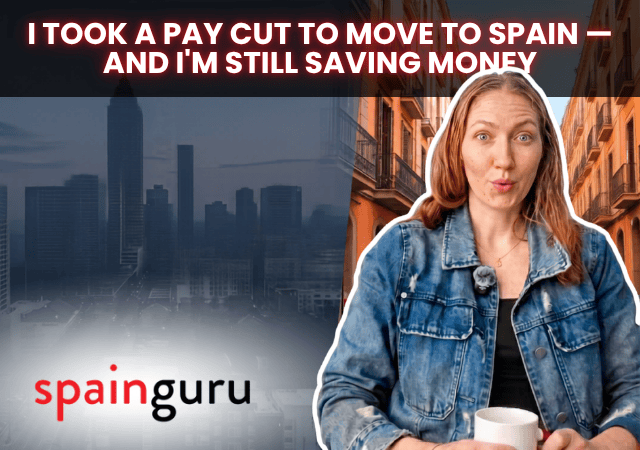
Julie Thompson left her public school teaching job in Atlanta for a part-time position in Barcelona. The cost of living in Spain is 37% cheaper than in the US for her — so even though she’s earning less now, she’s saving more money every single month. In this Spainguru interview, she breaks down exactly how, down to the dollar.
Planning your move to Spain?
Get the free step-by-step roadmap used by 10,000+ expats — covering visas, budget, housing, and the mistakes to avoid.
Start the Moving to Spain Hub →Meet Julie: From Atlanta Teacher to Barcelona Writer
Six months ago, Julie Thompson was living fifteen minutes north of Midtown Atlanta, working as a public school teacher, and dreaming about a different life. Today, however, she lives in Granollers — a small city about an hour’s train ride north of Barcelona — teaching English part-time at a private academy in Catalonia and building a writing career on the side.
Specifically, she made the move in September 2025. First, she sold her furniture. Then, she stored what she couldn’t carry with family and friends. Finally, she bought a one-way ticket on the strength of an Irish passport and a plan that was still taking shape.
Actually, the seed had been planted a couple of years earlier, during a summer she spent in a small Spanish town teaching English to the kids of a host family. As a result, she fell in love with the pace of life.
“I just kind of fell in love with the pace of life here. It seemed really laid back.”
🏥Looking for visa-compliant health insurance?
Get fully compliant, zero-waiting health insurance accepted by all Spanish consulates. Trusted by 150,000+ in our community.
Get a Free Quote →
The Irish Passport Shortcut
For most Americans, the hardest part of moving to Spain is the visa. However, Julie skipped the visa process entirely. In fact, her mother is fully Irish, which meant Julie was automatically entitled to Irish citizenship — and, consequently, EU residency rights. She just needed the passport.
“The process took about six months — mostly because they lost some of my documents. My mom is fully Irish, so automatically I have citizenship. I just needed the passport.”
Notably, if you have an Irish, Italian, Portuguese, or other EU grandparent, check your eligibility before you look at visas. Citizenship by descent can save you years compared to the standard non-lucrative visa or digital nomad visa routes. For readers with Spanish ancestry, meanwhile, our guide to the Ley de Nietos (grandchildren’s law) covers a similar shortcut. Additionally, those going the Irish route can check eligibility directly on the Irish Department of Foreign Affairs site.
From Public School Teacher to Part-Time Tutor
Julie made a deliberate trade. She had an advanced degree and multiple teaching certifications in the US. The job she took in Catalonia, however, was, as she puts it, “just a way to get to Spain.” The pay is less. The hours are fewer. That, indeed, was the point.
“With this new job, the fact that I only technically work part-time allows me to dedicate more hours to my writing craft.”
Moreover, she runs a blog called Rooted Abroad, where she tells expat stories — a project that would have been impossible on her old 24/7 American teaching schedule.
The Real Cost of Living in Spain vs the US
Here’s the breakdown Julie walked through on camera — same person, same lifestyle, two countries.
| Expense | Atlanta (US) | Barcelona (Spain) | Savings |
|---|---|---|---|
| Rent (private room) | $850 | $700 | −$150 |
| Cell + internet | $100 | $12 | −$88 |
| Health insurance | (from salary) | (public system) | — |
| Groceries | $400 | $300 | −$100 |
| Restaurants | $200 | $120 | −$80 |
| Gym | $50 | $35 | −$15 |
| Monthly total | $1,600 | $1,167 | −$433 (−27%) |
In particular, the line-item that shocks American readers most is the phone bill. Julie pays $12 a month in Spain for a plan comparable to what cost her $100 in Atlanta. Similarly, health care is another quiet win — in Spain, her coverage comes through the public system, funded by her taxes. For readers weighing options, our comprehensive guide to health insurance in Spain covers the private-vs-public choice in depth.
“For me, moving to Spain, I wasn’t sure if I would save money or not. Even though I make less money, I am saving money.”
What Surprised Her Most
“The stereotype that people don’t work very hard here is not really true. You have to kind of hustle no matter where you are.”
Actually, the real difference is cultural. Specifically, Spaniards work hard during work hours, but then they stop. Furthermore, people don’t define themselves by their jobs.
The one thing she didn’t see coming
“I thought the trains would be more effective. If I had known ahead of time, I might have thought twice about not having a car here.”
Julie commutes from Granollers on the Rodalies rail system, which has had a genuinely rough year. Consequently, anyone planning to live in Greater Barcelona and work in the surrounding towns should plan around this from day one.
The Hardest Parts
The commute. On one hand, Barcelona’s Metro works well; on the other hand, the regional trains that reach out into Catalonia are a different story.
Finding her people. Julie landed among other English teachers — a soft landing, but not the community she wanted. As a result, finding friends who share specific hobbies takes active effort.
“The more I put myself out there and go after the things I love, the more I’m meeting people who are doing the same thing. Barcelona is a big enough city where anything you’re interested in, it’s here.”
Why She Can’t Join Her Local Running Club
“Not speaking Catalan has prevented me from joining certain groups. The running club where I live — I haven’t joined just because everyone speaks Catalan there.”
In central Barcelona, Spanish will get you by. However, in the surrounding towns — including Granollers — Catalan is the default language of social life. Eventually, Julie is picking up phrases like adéu as a sign of respect.
Her Advice for Anyone Planning the Move
Overall, Julie’s practical checklist for the US-to-Spain transition boils down to four things:
- First, study the map and transit lines before signing a lease.
- Second, don’t buy a US phone before you leave. Spanish carriers are dramatically cheaper.
- Third, expect some US apps to stop working. Banking, some streaming, payment tools.
- Finally, budget for the intangibles — deposits, bureaucracy, utilities setup.
The Thing You Can’t Put a Price On
“It’s also just the quality of life. I’m less stressed here. And that’s not something you can really quantify in numbers.”
Ultimately, Julie isn’t just saving $433 a month. Additionally, she’s sleeping better, writing more, and when she leaves her school at the end of the day, she actually leaves. Still, Spain is not always dramatically cheaper than the US — but the texture of daily life shifts something fundamental.
“If you’re looking for a change and a more relaxed pace of life, I think Spain is a great option.”
Key Takeaways
- In summary, 37% cheaper to live in Spain — $1,167 vs $1,600.
- Notably, the phone bill gap is extreme — $12 vs $100.
- Moreover, EU ancestry is a visa shortcut worth checking.
- Additionally, lower pay can mean more savings when fixed costs fall faster than income.
- Finally, investigate train reliability if living outside central Barcelona.
- Overall, expect Catalan, not just Spanish, in Catalonia.
Interview recorded in Barcelona, March 31, 2026. Produced by Spainguru.
Get your free step-by-step Spain move plan
10 emails over 2 weeks covering visas, budget, housing & the mistakes to avoid.
Join 10,000+ expats who used this roadmap.
100% free · No credit card · Unsubscribe anytime