Last Updated on July 10, 2026 by Bruno Bianchi
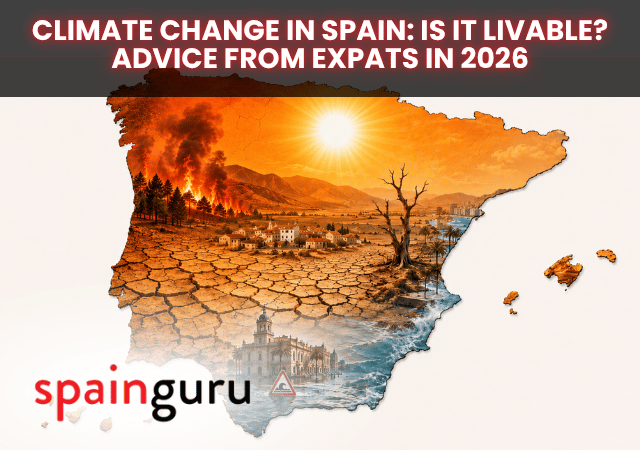
Few questions come up more often among newcomers than how climate change in Spain will affect daily life, especially as summer heatwaves grow longer and more intense. A member of a Spainguru Facebook group who is preparing to relocate later this year raised exactly this concern, asking how residents are coping and whether the Costa Brava and Girona region is a sensible choice.
The thread drew dozens of responses from people already living across the country, from Galicia and Asturias in the green north to Madrid, Valencia, Granada and the Canary Islands. Their answers paint a nuanced picture: the heat is real and worsening, but livability depends heavily on region, home construction, and personal habits.
Planning your move to Spain?
Get the free step-by-step roadmap used by 10,000+ expats — covering visas, budget, housing, and the mistakes to avoid.
Start the Moving to Spain Hub →This article preserves the original question and the community’s answers, then expands them into a practical guide on climate change in Spain, how it compares to conditions in the United States, and what prospective movers should weigh before choosing where to settle.
The Original Question About Climate Change in Spain
The member framed the discussion carefully and asked people to keep it constructive:
“Anyone who has moved to Spain – how concerned are you all about climate change and its impact on livability in Spain? These heatwaves are only going to get worse. We’re getting ready to move later this year and are curious about how folks are fairing. Especially in the Costa Brava / Girona region. Please don’t make responses political – looking for constructive perspectives, thanks!”
Climate Change in Spain: Answers from the Community
Responses ranged from reassurance to genuine concern, but most agreed the summers have grown noticeably hotter over the past few decades. Several long-term residents said the season of extreme heat has stretched from a few weeks in August to three or four months.
Not sure which city is right for you?
Compare cost of living, weather, expat community size, and lifestyle across 13 Spanish cities in our free guide.
Explore Cities →“Anything from Madrid, down, will be a desert sooner than people think. It’s already miserably hot. We’ve been here ten years and every summer has been hotter than the last. 40 years ago, when I lived in Barcelona for three years, summer was warm, but never a sweltering inferno, like now.”
“I’m from Madrid and 30-40 years ago we used to have 1 rarely 2 heat waves per summer. Now there is one after the other. Madrid was always hot even before the nonstop heatwaves but now you better have AC or it is absolutely unbearable.”
“I have lived in the south of Spain for 8 years and it has gotten progressively hotter each year. And there is less rain and little shade. It is likely that I will relocate to somewhere more temperate in the not too distant future.”
Others urged perspective, pointing out that extreme heat is a global phenomenon and that Spain is far from the worst-affected place.
“It’s no worse than virtually the entire southern half of the US or anywhere in Central America, many parts of Asia, and many other places in the world, so from a livability perspective I am not finding myself worse off.”
“The excessive heat is all over Europe and the rest of the world. It is still liveable unlike other planets, though.”
Comparing Spain’s Heat to Arizona and Texas
A recurring debate compared Spanish summers to the American Southwest. Some argued that dry-heat states like Arizona are more manageable, while others stressed that infrastructure and humidity change the equation.
“I mean, compared to Texas and Arizona, it can’t compete in my opinion.”
“But AZ has no humidity. I never realized how humid Spain is until we moved to Valencia. The difference is infrastructure for AC and the ability to afford it.”
“110 today in Austin. Spain is not nearly as hot as here.”
Humidity and the Coastal Difference
Members with science backgrounds explained why humid heat feels more dangerous than dry heat, and why coastal cities stay cooler.
“Water conducts heat 25x faster than air. When you sweat, that sweat evaporates off the skin and cools us. When the air is humid, the sweat doesn’t have a chance to evaporate as quick, so it imparts the cooling to the humid air, not your skin. As you age, your ability to handle heat goes way down.”
“Coastal cities are cooled by breezes and a nearby cooler mass of water. That cooling effect is highly localized. Most of the southern states in the US are equally as hot on average as most of southern Europe, plus they have high humidity.
Climate Change in Spain by the Numbers
Community members are right to focus on lived experience, but official data backs up what many residents are noticing. Climate change in Spain is measurable, and the trend points to hotter summers and growing water stress rather than temperature alone.
- Spain’s average annual temperature rose by almost 1.7C between 1961 and 2024, according to AEMET, the national weather agency.
- 2025 was Spain’s third-warmest year on record, with 25 single-day heat records, based on AEMET data reported by France 24.
- The summer of 2025 was the hottest ever recorded in Spain, averaging roughly 24.2C on the mainland, around 2.1C above the 1991-2020 norm.
- Spain is warming about 1.6 times faster than the global average, according to climate analysis from the Real Instituto Elcano.
- About 74% of Spain’s territory is susceptible to desertification, according to the government’s National Strategy to Combat Desertification.
- National climate projections point to lower average rainfall through this century, with more arid conditions and greater wildfire and heat exposure risk.
For someone relocating, these numbers reinforce the community’s practical advice on climate change in Spain: insulation, air conditioning, and regional choice matter more with each passing year, and long-term water availability deserves as much attention as peak temperatures.
Climate Change in Spain: Why Northern and Coastal Regions Stay Cooler
The strongest consensus in the thread was geographic: the further north and closer to the Atlantic you live, the milder the summer. Several members had specifically chosen the green north to soften the impact of climate change in Spain.
“Just moved to Oviedo for that reason. The green Spain is ten degrees cooler in summer and often 10 degrees warmer in winter than Madrid. Today’s temperature is high 77F, low 63F, cool breeze.”
“That played a part in my choice to move to Galicia. The coastal areas are much more moderate and temperate. We definitely got hit with the heat waves, but not as bad as inland or Madrid. Right now it’s 75F each day.”
Galicia, Asturias, the Basque Country, Navarra and the northern coast were named repeatedly as cooler alternatives, along with the Canary Islands, where Atlantic trade winds keep temperatures moderate year round. If you are still deciding where to settle, Spainguru’s Spain city finder and its regional destination guides can help you compare climates side by side.
Even northern residents cautioned that no region is fully immune. One member near Bilbao noted the city recently hit 43C, and several reported record temperatures reaching further north into France, Belgium and Germany. Spain’s national weather agency AEMET has logged a run of record-breaking summers across the country.
Climate Change in Spain and Home Construction: Why Insulation Matters
A theme almost as prominent as region was the quality of the home itself. Many argued that the building matters as much as the climate when coping with climate change in Spain.
“Most Spanish buildings are cheaply built with cement and have limited insulation and are not energy efficient, so the extreme temperatures and humidity make things really miserable both in the summer and winter.”
“Our house here has 16 inch thick walls of poured concrete and is built to weather the heat. It’s cool inside even on the hottest days. The downside is that it’s also fairly cool in the winters.”
Opinions split on whether old or new construction is better. Some praised thick-walled older homes with small windows and shutters; others found the same homes stifling without cross ventilation. The practical advice was to check a property’s orientation, shade, window quality and airflow before committing. These are exactly the kinds of details worth building into your move to Spain planning.
Spain vs the United States: How the Heat Really Compares
Part of the thread turned to a statistical debate about heat-related deaths in Europe versus the United States. One member cited figures suggesting far more heat deaths in Europe, while another with a research background cautioned that the two regions measure such deaths differently.
“Death data comes from the official sources available in each country. In the US it is based on the official cause of death listed on the death certificate. In Europe, the numbers come from modeling, estimating the numbers in which heat may have played a role. A significantly larger percentage of buildings and homes in the US have air conditioning, and the percentage of the population over 65 is higher in Europe as well.”
The takeaway for movers is less about the raw numbers and more about the underlying factors: air conditioning availability, building efficiency, age, and access to cooling all shape how survivable a heatwave is. Comparing costs of adapting a home is also worth folding into your broader cost of living in Spain planning.
Climate Change in Spain: Practical Ways Residents Cope with the Heat
Beyond region and construction, members shared the daily habits that make Spanish summers manageable. The consensus was that adapting to a local rhythm matters more than fighting the heat.
Adjusting Your Daily Routine
“I just go out in the morning or in the evening and avoid being outside during the hottest part of the day. If I have to go out, I look for air-conditioned places like malls, gyms, or public buildings. It takes a bit of adjusting, but after a while it just becomes part of your routine.”
Several noted that Spanish life is already structured around the heat, with businesses closing during the hottest hours and schools breaking from late June to mid-September. On the Costa Blanca and in Girona, members said they simply wait until the evening to walk or run.
Cooling an Older Spanish Home
“We close the shutters in the morning and open all the windows at night to let the evening cool winds in with cross ventilation. Our piso has thick walls and it’s often way cooler inside than out.”
Others invested in modern systems: solar panels to offset electricity costs, minisplit heat pumps in every room, and pools or shaded terraces. Contrary to a common myth, members insisted air conditioning is now widespread and legal across Spain, though it was rare a generation ago.
Climate Change in Spain and the AMOC Debate
A more forward-looking sub-thread discussed the possible weakening of the Atlantic Meridional Overturning Circulation, the current system that includes the Gulf Stream. Members disagreed about what a disruption would mean for the Iberian Peninsula.
“If the AMOC collapses, the heat is not really the problem. Europe could see average temperatures drop, leading to brutal, extended winters. But most projections show that Spain will not cool like the northern areas of Europe. The southern areas, Spain, Greece, Italy, will likely get hotter and drier, with drought the biggest problem.”
The general view was that any dramatic AMOC-driven shift is more likely to affect the next generation than current movers, but that drought and water scarcity are the trends to watch in Spain over the coming decades. A recent study cited in the thread warned that 50C could eventually be reached in Catalonia.
Climate Change in Spain: Conclusion and Takeaways
The community’s collective message is that climate change in Spain is real and worth taking seriously, but it does not make the country unlivable. The summers are hotter and longer than they were decades ago, yet Spain remains comparable to, and often more manageable than, large parts of the United States and southern Europe.
For someone eyeing the Costa Brava and Girona, the north-eastern coast is cooler than inland or southern Spain, though still warm at the peak of summer. Movers who prioritize a temperate climate consistently pointed to Galicia, Asturias, the Basque Country and the Canary Islands, while stressing that a well-insulated, well-oriented home with good ventilation or air conditioning matters just as much as the region.
The practical formula that emerged was simple: choose your region for climate, choose your home for efficiency, and adapt your routine to the local rhythm. Do those three things and Spanish summers become a manageable trade-off for the country’s many other advantages.
Start planning your move with Spainguru’s Move to Spain Planning Hub, and explore Spainguru’s vetted service providers for legal help, health insurance, and tax advice. Here you can find Spainguru’s recommended NLV related services: https://spainguru.es/services-for-spanish-visas/.
To compare notes with others already living through Spanish summers, browse all Spainguru Facebook communities here: https://spainguru.es/spainguru-facebook-groups-and-spainguru-community/.
This article is based on personal opinions from the Spainguru community and is not legal advice.
Climate Change in Spain: FAQ
Is the Costa Brava and Girona region a good choice given climate change in Spain?
The north-eastern coast is generally cooler than inland or southern Spain thanks to its latitude and sea breezes, though it still gets hot in July and August, with Girona reaching the high 30s Celsius during heatwaves. Members considered it more livable than Madrid or Andalusia, but recommended checking that any home has good insulation, shade and cooling.
Which regions of Spain stay coolest in summer?
Community members repeatedly named Galicia, Asturias, the Basque Country, Navarra and the northern Atlantic coast as the coolest mainland regions, along with the western Canary Islands, where trade winds keep temperatures moderate year round. These areas are wetter and greener but far milder in summer.
Does Spain have air conditioning?
Yes. While air conditioning was rare a generation ago, members said it is now widespread and legal across Spain, and increasingly considered essential in inland and southern areas. Older buildings may only have a unit in one room, so it is worth checking coverage before renting or buying.
How hot does it actually get in Spain?
During recent heatwaves members reported readings around 38-45C in inland and southern cities, including Bilbao in the north hitting the low 40s. Northern coastal areas often stayed in the mid-20s to 30s Celsius. Records are being set more frequently, and one study cited in the thread warned Catalonia could eventually reach 50C.
How do residents cope with Spanish summer heat?
The most common strategies were going out only in the morning and evening, closing shutters during the day and ventilating at night, using air-conditioned public spaces, and staying hydrated. Many also aligned with the Spanish rhythm of pausing activity during the hottest hours.
Is climate change in Spain worse than in the United States?
Members were divided. Some argued dry-heat US states are more bearable and better equipped with air conditioning, while others noted much of the southern US is equally hot with higher humidity. Differences in how heat deaths are measured make direct comparisons unreliable.
Should climate change stop me from moving to Spain?
The prevailing view was no, provided you choose your region and home wisely. Spain remains livable and, for many, more comfortable than where they moved from, as long as you plan for hotter, longer summers and prioritize a cool, efficient home.
Get your free step-by-step Spain move plan
10 emails over 2 weeks covering visas, budget, housing & the mistakes to avoid.
Join 10,000+ expats who used this roadmap.
100% free · No credit card · Unsubscribe anytime