Last Updated on October 16, 2026 by Bruno Bianchi
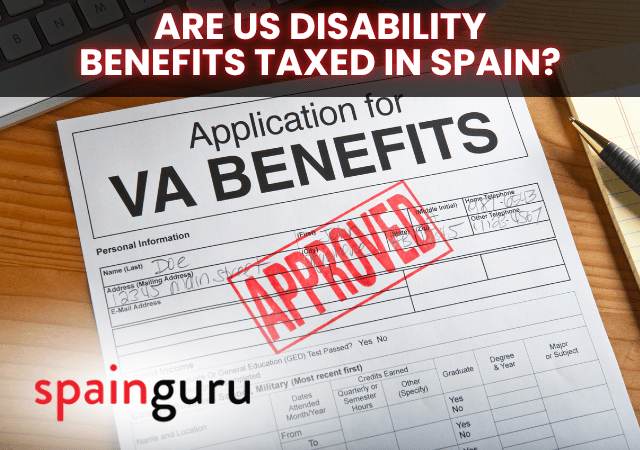
Are US disability benefits taxed in Spain? If you receive VA disability compensation, Social Security Disability Insurance (SSDI) or another disability benefit and you live in Spain as a tax resident, the answer is not a simple yes or no. The disability benefits tax Spain question depends on Spanish tax law, a 2019 Supreme Court ruling, a 2020 binding ruling from the tax authorities and, for some benefits, the US-Spain tax treaty.
A tax preparer who works with Americans in Spain posted a summary of the issue in Spainguru’s American Expats in Spain Facebook group, after seeing the same question asked again and again. Two members replied with the VA and SSDI angles. Together they cover the exemption in article 7 of the Spanish income tax law, why a foreign disability rating does not automatically qualify, and what happens if the Spanish tax agency challenges your position.
Planning your move to Spain?
Get the free step-by-step roadmap — covering visas, budget, housing, and the mistakes to avoid.
Start the Moving to Spain Hub →This article keeps the original post and the replies as they were written, then explains each part of the disability benefits tax Spain question in plain English, with a few corrections where the thread simplified the law.
The original post about disability benefits tax in Spain
“Disability benefits – taxation in Spain. I see a few posts asking whether Spain taxes disability benefits or not. The answer is nuanced. Article 7 of the LIRPF (Spanish tax law) exempts disability benefits fully or partially depending on the amount of disability (33/65/100%).
But court decision EDJ219/523651 ruled that just because a foreign government determined disability does not mean those benefits are automatically exempt from taxation in Spain. The most conservative path IMO would be to get a determination of disability by the Spanish SS Institute and use whatever percentage they determine you have.
If not, then one would be to report it as taxable (nobody wants that I understand that). And it goes against the principles of US taxation, you live in Spain though, no the US.
Confused about Spanish taxes?
Spainguru’s vetted tax advisors specialize in expat tax situations — US/Spain treaties, Modelo 720, Beckham Law, and more.
Meet Tax Experts →You could take the position that is not taxed by virtue of article 7 alone and look no further. However this position could be challenged by Hacienda in an audit and the taxpayer would be required to pay the tax, interest and penalties. The taxpayer can of course ask for relief of the tax based on the law or the interest and penalties based on due care and prudence (diligencia necesaria en el cumplimiento de las obligaciones tributarias), or both.
But this request for relief can be put to the test itself if it is found that you knew or should have known of the standards including the court decision. I do not think the taxpayer would get relief based on the law unless the court decision is overturned or the law changed. Relief on penalties is more likely but still not guaranteed.
I could write or tell people “Disability benefits are not taxed in Spain, do not worry about it, do not report it”. But that is not IMO the right thing to do for me.
Could a tax position be taken that US disability is tax exempt in Spain based solely on article 7? Yes. Can I, not you, be sure that it will survive scrutiny? No. Ultimately, it is the taxpayer after proper advice and consideration who decides what tax position he or she takes. Good luck everybody.”
Disability benefits tax Spain: answers from the community
“Seems irrelevant, as VA disability is a government pension.”
“You could take that position that if you receive VA disability due to an injury suffered while in the service to the government, that should be considered a pension from government service. That is a matter of interpretation, but is not automatic. The language that would matter would be article 21 of the treaty “… in respect of services rendered to that State or subdivision or authority…”. If you successfully argue this is the case, then it would be irrelevant. And even if this is true, there are other non-VA type of disability benefits.”
“SSDI is taxed in Spain until your diagnosis is registered with them . VA isn’t.”
Disability benefits tax Spain: what article 7 of the LIRPF exempts
Article 7 of the Ley del IRPF lists income that is exempt from Spanish income tax. Two letters matter for disability benefits. Letter f) exempts benefits for incapacidad permanente absoluta or gran invalidez, but only when they are paid by Social Security or by an institution that replaces it (certain mutual benefit societies qualify too, with their own conditions and a cap). Letter g) exempts permanent-incapacity pensions under Spain’s own Clases Pasivas regime for public servants, when the condition prevents any work at all. It does not extend automatically to foreign government disability payments.
So the exemption has two separate conditions: who pays the benefit, and how severe the incapacity is. The incapacity must match one of the two highest Spanish categories, absolute permanent incapacity (unable to work in any profession) or gran invalidez (needing help from another person for daily life). A partial incapacity, or a total incapacity for your own profession only, does not qualify.
One correction to the original post: the article 7 exemption is not tiered by 33, 65 or 100 percent. Those percentages belong to the mínimo por discapacidad, a separate allowance in the income tax calculation that uses only two thresholds, 33 and 65 percent, with standard amounts of 3,000 and 9,000 euros, plus regional variations. The 100 percent figure is not a third step. And the disability percentage certificate is issued by IMSERSO or the regional authority, which is a different procedure from the INSS incapacity assessment that matters for the exemption.
For an overview of how Spanish residents are taxed on foreign income, see Spainguru’s guide to Spanish taxes for expats.
The 2019 Supreme Court ruling on foreign disability pensions
The court decision the original post refers to is Supreme Court ruling 346/2019 of 14 March 2019. A Spanish resident received a disability pension from Switzerland based on a 100 percent Swiss disability rating and claimed the article 7.f) exemption. The tax agency refused, the regional court agreed with the tax agency, and the Supreme Court dismissed the taxpayer’s appeal.
The court’s reasoning is the part that matters for Americans asking the disability benefits tax Spain question. A foreign rating, even 100 percent, is not automatically equivalent to Spanish absolute permanent incapacity, because other countries’ systems do not draw the same line between being unable to do your own job and being unable to do any job. Whether a foreign condition meets the Spanish standard is for the INSS (Instituto Nacional de la Seguridad Social) to assess through its disability evaluation teams, and the taxpayer has to give the INSS enough medical evidence to do so. In the Swiss case, the INSS declined to evaluate because the documents were insufficient, and the taxpayer lost.
The ruling does not say foreign disability pensions are always taxable. It says the exemption is available when the taxpayer proves the Spanish-law equivalence. That is why the tax preparer’s “most conservative path” is to ask the INSS for a Spanish determination. Without it, the exemption rests on your own reading of article 7, which the tax agency can challenge, and a US rating alone will not carry the argument.
Disability benefits tax Spain: VA disability compensation
Two members argued that VA disability compensation is a different case because it is paid by the US government for injuries suffered in military service. The relevant text is article 21 of the US-Spain tax treaty, which covers remuneration and pensions paid by a state for services rendered to that state. If VA compensation falls under article 21.2, it is taxable only in the United States and the Spanish exemption question does not arise, with one exception: article 21.2(b) gives Spain the exclusive right to tax it when the recipient is both a Spanish resident and a Spanish national, which affects dual citizens.
The Spanish tax authorities have looked at this exact situation. Binding ruling V0249-20 of 4 February 2020 from the Dirección General de Tributos concerned a US citizen living in Spain whose only income was VA disability compensation for a service-connected disability rated at 100 percent. The ruling examined articles 20 and 21 of the treaty and article 7.f) of the LIRPF. It did not declare every VA payment a government pension; it set out how the benefit is taxed depending on how it is classified. If article 21 does not apply, Spain can tax the payment under the treaty’s other provisions, and the VA is not automatically treated as a body that replaces Social Security for article 7.f) purposes.
The tax preparer’s reply was that the article 21 position is reasonable but a matter of interpretation, not an automatic rule. A tax advisor who files in both countries should look at your award letter and your nationality before you rely on it.
Disability benefits tax Spain: SSDI and other US benefits
SSDI is a Social Security benefit, so it falls under article 20.1(b) of the treaty, not under the government-service rules of article 21. Article 20.1(b) lets the United States tax its Social Security benefits, and it does not stop Spain from taxing them as well under Spanish law. So for a Spanish tax resident the disability benefits tax Spain answer for SSDI is yes, it is taxable, unless the article 7.f) exemption applies.
One member summed up the practical position as “SSDI is taxed in Spain until your diagnosis is registered with them”. The direction is right, although there is no registration step. You need to show that the incapacity behind the US benefit meets the Spanish standard of absolute permanent incapacity or gran invalidez, following the 2019 ruling, and that the paying body qualifies under article 7.f). A Social Security Administration finding on its own is not enough.
Private disability insurance payouts, employer long-term disability plans and state disability programmes are each a separate analysis. Article 7.f) does not exempt a private insurance payment just because it compensates a severe disability; the legal nature of the payer and of the benefit decides, and different payments can fall into different income categories in Spain. This is where a generic answer stops being useful and a case-by-case review starts.
What happens if Hacienda challenges your disability benefits tax position
The original post walks through the downside. If you treat the benefit as exempt, do not declare it and the Agencia Tributaria rejects the exemption, it can assess the tax owed plus late-payment interest. A penalty is a separate step and is not automatic: the tax agency has to establish an infringement and show culpability. Under article 179.2(d) of the General Tax Law there is no penalty when the taxpayer acted with due care, including relying on a reasonable interpretation of the law. Due care protects you from the penalty, not from the tax or the interest.
The tax preparer’s view was that the exemption argument is hard to win on a US rating alone, and that penalty relief is more likely but not guaranteed, especially if the tax agency can show you knew about the 2019 ruling. The exemption can still succeed under that ruling if you meet its conditions; what fails is a claim with no Spanish-law evidence behind it.
Spain’s general limitation period for assessing income tax is four years, counted from the day after the filing deadline. Certain tax agency actions and appeals interrupt and restart that period, so an undeclared benefit can be reassessed for several years back.
Disability benefits tax Spain: the options on the table
The thread leaves taxpayers with these positions on the disability benefits tax Spain question.
- Ask the INSS for a Spanish incapacity assessment, provide full medical evidence, and claim the article 7.f) exemption only if the INSS recognises absolute permanent incapacity or gran invalidez and the paying body qualifies.
- Declare the benefit as taxable income in Spain. If it is SSDI and you actually paid US tax on it, a foreign tax credit may be available under article 24 of the treaty and article 80 of the LIRPF, within the statutory limits; it does not cover US tax charged only because of citizenship.
- For VA compensation, the article 21 government-service argument, which keeps the benefit out of Spanish tax if it holds and you are not a Spanish national.
Claiming the exemption on the strength of a US percentage alone is not a less conservative option; after the 2019 ruling it is an unsupported position that invites an assessment with interest and possibly a penalty.
Disclosure: Spainguru’s partners pay a listing fee or a commission per conversion. If you want a professional opinion on your own benefit, Spainguru works with tax experts who file in both Spain and the US, and keeps a list of tax accountants and gestores in Spain.
Disability benefits tax Spain: conclusion
US disability benefits are not automatically exempt in Spain. Article 7.f) of the LIRPF exempts benefits for absolute permanent incapacity and gran invalidez paid by Social Security or an equivalent body, and since the 2019 Supreme Court ruling the Spanish tax agency expects that equivalence to be proven through the INSS, not assumed from a foreign rating. SSDI is the clearest case of a benefit that is taxable until you meet those conditions. VA disability compensation may escape Spanish tax under the treaty’s government-service article, as the 2020 DGT ruling discusses, but that depends on classification and on your nationality.
The tax preparer who wrote the original post refused to tell people the benefit is simply untaxed, and the reason is the audit risk described above. Get advice before you file your first Spanish return, decide which position you can defend with evidence, and keep the paperwork that supports it.
Here you can find Spainguru’s recommended NLV related services: https://spainguru.es/services-for-spanish-visas/
Start planning your move with Spainguru’s Move to Spain Planning Hub, and explore Spainguru’s vetted service providers for legal help, health insurance and tax advice.
Join Spainguru’s Spain Non Lucrative Visa Facebook group here: https://www.facebook.com/groups/spanishnlv. For more community channels, visit the Spainguru Community Hub.
This article is based on personal opinions from the Spainguru community and general information about Spanish law. It is not legal or tax advice.
Disability benefits tax Spain FAQ
Are VA disability benefits taxed in Spain?
Possibly not, if they are classified as a government-service pension under article 21.2 of the US-Spain tax treaty, which makes them taxable only in the US, unless you are also a Spanish national. The DGT addressed this case in binding ruling V0249-20. The classification is not automatic, so confirm it with a cross-border tax advisor.
Is SSDI taxed in Spain?
Yes, as a general rule. Article 20.1(b) of the treaty lets the US tax it and does not stop Spain from taxing it too. It is exempt only if the article 7.f) conditions are met, including proof that the incapacity meets the Spanish standard of absolute permanent incapacity or gran invalidez.
What does article 7 of the LIRPF exempt?
Letter f) exempts absolute permanent incapacity and gran invalidez benefits paid by Social Security or a body that replaces it. Letter g) exempts incapacity pensions under Spain’s Clases Pasivas regime that prevent any work. Neither covers partial or own-profession incapacity, and neither applies to a foreign government payment automatically.
Do the 33, 65 and 100 percent disability thresholds affect the exemption?
No. The 33 and 65 percent thresholds apply to the mínimo por discapacidad, an allowance in the income tax calculation, and there is no 100 percent step. The article 7 exemption depends on the category of incapacity and on who pays the benefit, not on a percentage.
How do I get a Spanish incapacity assessment?
You apply to the INSS, which assesses whether your condition amounts to absolute permanent incapacity or gran invalidez. Bring full medical evidence; in the 2019 case the INSS declined to evaluate because the documents were insufficient. A disability percentage certificate from IMSERSO or your region is a different document and does not replace this assessment.
What happens if I do not declare a disability benefit and Hacienda audits me?
The tax agency can assess the tax owed plus interest. A penalty requires a finding of culpability; if you relied on a reasonable interpretation of the law you may avoid it under article 179.2(d) of the General Tax Law, but you still owe the tax and interest.
Does the disability benefits tax Spain question affect my visa?
Not directly. Visa income requirements and tax treatment are separate tests. Many retirees on the non lucrative visa use disability income to qualify; what you declare in Spain once you are a tax resident is a different question.
Get your free step-by-step Spain move plan
10 emails over 2 weeks covering visas, budget, housing & the mistakes to avoid.
Free, from the team behind a community of 225,000+ expats.
100% free · No credit card · Unsubscribe anytime