Last Updated on October 26, 2026 by Bruno Bianchi
Spain wealth tax by region is one of the first things to check before you pick where to live, because the same net worth can mean a zero bill in Madrid and a five-figure bill in Catalonia. The tax is national in name, but each autonomous community sets its own allowance, its own rate scale and its own relief, and in 2026 the gap between regions is wider than ever.
By the end of this guide you will know how the Spanish wealth tax (Impuesto sobre el Patrimonio) is calculated, what every region charges in 2026, how three typical expat profiles compare across the map, and what you would pay yourself, using the calculator further down. Let’s start with the map.
Planning your move to Spain?
Get the free step-by-step roadmap — covering visas, budget, housing, and the mistakes to avoid.
Start the Moving to Spain Hub →Spain wealth tax by region: the 2026 map
The map below shows the allowance each region applies before any tax is due, and the colour shows what happens above it. Six regions cancel the tax with a 100% bonus, two apply a partial bonus, two have raised the allowance to 2 or 3 million euros, and the rest collect the tax in full from 500,000 or 700,000 euros.
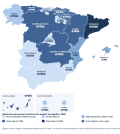
Two things stand out. First, the regions that attract the most foreign residents sit at opposite ends: Madrid and Andalusia charge nothing, while Catalonia starts collecting at 500,000 euros and the Balearic Islands only at 3 million. Second, the Valencian Community has moved from the expensive group to the cheap group by raising its allowance to 2 million euros for the tax accruing on 31 December 2026. If you want your own number first, jump straight to the calculator.
How the Spanish wealth tax works
The wealth tax is an annual tax on the net worth of individuals, and tax residents are taxed on their worldwide assets. The rules come from Law 19/1991, but the regions can change the allowance, the scale, and the bonus, which is why the by-region view matters so much. If you want the full background on what counts as an asset and how property is valued, Spainguru’s guide on what the Spanish wealth tax is covers it in detail.
The allowance and the main-home exemption
Under the state rules, the first 700,000 euros of net wealth per person is exempt. Your main home in Spain gets a separate exemption of up to 300,000 euros per owner, so a couple who own their 600,000 euro home together pay nothing on it.
Confused about Spanish taxes?
Spainguru’s vetted tax advisors specialize in expat tax situations — US/Spain treaties, Modelo 720, Beckham Law, and more.
Meet Tax Experts →Regions can move the general allowance. Catalonia and Extremadura cut it to 500,000 euros, Valencia raised it to 2 million and the Balearic Islands to 3 million. The Basque Country and Navarra, which run their own tax systems, use 800,000 and 550,000 euros respectively, with Gipuzkoa at 700,000.
The rate scale
Whatever is left after the allowance is taxed on a progressive scale. The state scale starts at 0.2% and rises in eight steps to 3.5% on net wealth above 10.7 million euros. Several regions apply their own scale: Catalonia tops out at 3.48%, the Balearic Islands at 3.45%, Asturias at 3%, Cantabria at 3.03% and Extremadura at 3.75%.
The regional bonus, and why Madrid pays nothing
A bonus (bonificación) is a discount on the final tax bill. Madrid, Andalusia, Cantabria, Extremadura, La Rioja and Murcia apply a 100% bonus, which cancels the regional wealth tax for fortunes below the solidarity-tax threshold; what happens above it is explained in the next section. Galicia applies 50%, and Ceuta and Melilla 75% on assets located in the two cities.
The solidarity tax on large fortunes
In 2022 the state created the Impuesto Temporal de Solidaridad de las Grandes Fortunas under Law 38/2022, precisely to catch wealthy residents of the regions with a 100% bonus. It applies to net wealth above 3 million euros, which in practice means above roughly 3.7 million once the 700,000 euro allowance is counted (more if you hold other exempt assets), at rates of 1.7% to 3.5%. Whatever regional wealth tax you have already paid is credited against it.
A 100% bonus therefore protects you only up to the solidarity threshold. In Madrid a typical resident pays nothing until roughly 3.7 million euros of net wealth, and above that the solidarity tax applies instead; the exact point depends on your exemptions and on the 60% income cap described below. Most regions with a bonus have now made it “variable” so that the money goes to the region rather than to Madrid’s central government, but the total you pay is the same.
Other rules worth knowing
Even if nothing is due, you must file a return (Modelo 714) when your gross assets exceed 2 million euros. There is also a 60% cap: your income tax and wealth tax together cannot exceed 60% of your taxable income, and the wealth tax is reduced by up to 80% to respect that cap, which helps retirees with large assets and modest income.
Non-residents, and people taxed under the Beckham Law, only pay on assets located in Spain. Spainguru’s Beckham Law guide explains how that regime interacts with the wealth tax.
Wealth tax allowances, rates and bonuses in every region (2026)
This is the complete picture for Spain wealth tax by region in 2026. The allowance is per person, the main-home exemption of 300,000 euros applies on top everywhere except the Basque Country (400,000) and Navarra (250,000), and the rate shown is the top of the regional scale.
| Region | Allowance | Rate scale | Bonus | What you pay in practice |
|---|---|---|---|---|
| Madrid | 700,000 € | State, 0.2% to 3.5% | 100% | Nothing until about 3.7M, then the solidarity tax |
| Andalusia | 700,000 € | State, 0.2% to 3.5% | 100% | Nothing until about 3.7M, then the solidarity tax |
| Cantabria | 700,000 € | Own, 0.24% to 3.03% | 100% | Nothing until about 3.7M, then the solidarity tax |
| Extremadura | 500,000 € | Own, 0.3% to 3.75% | 100% | Nothing until about 3.7M, then the solidarity tax |
| La Rioja | 700,000 € | State, 0.2% to 3.5% | 100% | Nothing until about 3.7M, then the solidarity tax |
| Murcia | 700,000 € | State, 0.2% to 3.5% | 100% | Nothing until about 3.7M, then the solidarity tax |
| Galicia | 700,000 € | State, 0.2% to 3.5% | 50% | Half the state tax above 700,000 |
| Ceuta and Melilla | 700,000 € | State, 0.2% to 3.5% | 75% on local assets | A quarter of the tax on assets in the cities |
| Valencian Community | 2,000,000 € | Own, 0.25% to 3.5% | None | Full tax above 2M (accrual 31 Dec 2026; 1M before) |
| Balearic Islands | 3,000,000 € | Own, 0.28% to 3.45% | None | Full tax above 3M |
| Catalonia | 500,000 € | Own, 0.21% to 3.48% | None | Full tax above 500,000, among the highest bills in Spain |
| Aragón | 700,000 € | State, 0.2% to 3.5% | None | Full tax above 700,000 |
| Asturias | 700,000 € | Own, 0.22% to 3% | None | Full tax above 700,000 |
| Canary Islands | 700,000 € | State, 0.2% to 3.5% | None | Full tax above 700,000 |
| Castile and León | 700,000 € | State, 0.2% to 3.5% | None | Full tax above 700,000 |
| Castilla-La Mancha | 700,000 € | State, 0.2% to 3.5% | None | Full tax above 700,000 |
| Navarra (foral) | 550,000 € | Own, 0.16% to 3.5% | None | Own regime, with its own large-fortunes tax |
| Basque Country (foral) | 800,000 € (700,000 in Gipuzkoa) | Own, 0.2% to 2.5% | None | Own regime, with its own large-fortunes tax |
Sources: the regional tax rules as compiled by Guía Fiscal and the Agencia Tributaria manual. Regional budgets change these figures almost every year, so check the current rule for your region before filing.
Spain wealth tax by region: three worked examples
The three profiles below are tax residents, the figures are per person and per year, and the main home is assumed to be worth at least 300,000 euros so the full home exemption applies. They show the regional calculation before the 60% income cap, special exemptions and individual deductions, so they are illustrations rather than estimates of your final bill.
Example 1: a retired couple with 900,000 euros each
Each spouse owns half of an 800,000 euro home (400,000 each) and 500,000 euros in savings and investments. Net wealth is 900,000 euros per person; after the 300,000 home exemption and the 700,000 allowance, the taxable base is zero.
Result: no wealth tax in most of Spain. Catalonia, with its 500,000 euro allowance, taxes a base of 100,000 euros at about 210 euros per person, and Navarra, with a 550,000 euro allowance and a 250,000 euro home exemption, charges about 160 euros. For most retirees moving to Spain the wealth tax is a non-issue, whatever the region.
Example 2: 2 million euros including a 500,000 euro home
This is the profile that appears in most Spainguru webinar questions: a 500,000 euro main home plus 1.5 million euros in investments, pensions already drawn and cash. The taxable base under the state rules is 1 million euros.
| Region | Taxable base | Tax before relief | Wealth tax paid |
|---|---|---|---|
| Madrid, Andalusia, Murcia, La Rioja | 1,000,000 € | about 5,490 € | 0 € |
| Cantabria and Extremadura (own scales) | 1,000,000 € | about 6,655 € and 8,235 € | 0 € |
| Galicia | 1,000,000 € | 5,490 € | about 2,745 € |
| Valencian Community | 0 € | 0 € | 0 € (about 3,460 € under the old 1M allowance) |
| Balearic Islands | 0 € | 0 € | 0 € |
| Aragón, Canary Islands, Castile and León, Castilla-La Mancha | 1,000,000 € | 5,490 € | about 5,490 € |
| Asturias | 1,000,000 € | 6,170 € | about 6,170 € |
| Catalonia | 1,200,000 € | 7,655 € | about 7,655 € |
The spread is zero to 7,655 euros a year on identical wealth. Over a ten-year retirement that is the price of a car, which is why so many community members ask about Spain wealth tax by region before they choose a city.
Example 3: 5 million euros including a 1 million euro home
Now the solidarity tax enters the picture. Net wealth is 5 million euros per person, the state taxable base is 4 million, and the solidarity tax on the part above 3 million is 17,000 euros.
| Region | Regional wealth tax paid | Solidarity tax top-up | Total per year |
|---|---|---|---|
| Madrid, Andalusia and other 100% bonus regions | 0 € | 17,000 € | about 17,000 € |
| Balearic Islands | about 18,000 € | 0 € | about 18,000 € |
| Galicia | about 24,220 € | 0 € | about 24,220 € |
| Valencian Community | about 32,800 € | 0 € | about 32,800 € |
| Aragón, Canary Islands, Castile and León, Castilla-La Mancha | about 48,450 € | 0 € | about 48,450 € |
| Catalonia | about 54,440 € | 0 € | about 54,440 € |
| Asturias | about 55,520 € | 0 € | about 55,520 € |
At this level the 100% bonus regions still win, but the gap narrows: 17,000 euros in Madrid against 54,000 in Catalonia. Above roughly 10 million euros the solidarity tax and the regional taxes converge, because both top out at 3.5%.
Calculate your wealth tax by region
Enter your own figures to compare regions. The calculator uses the 2026 allowances, scales and bonuses from the table above, adds the solidarity tax where it applies, and shows the result per person.
Estimates the annual Impuesto sobre el Patrimonio for a Spanish tax resident, per person, using the 2026 regional allowances, scales and bonuses. It adds the national solidarity tax where it applies. Approximate and for orientation only.
Simplifications: it ignores other exemptions (family business, pension plans, certain art), the 60% income-plus-wealth-tax cap, and debts beyond what you net off yourself. Basque and Navarra scales are approximated. The Valencia allowance of 2 million euros applies to the tax accruing on 31 December 2026. Not tax advice.
For income tax, social security and the rest of your Spanish tax picture, Spainguru’s Spain tax calculator and the guide to Spanish taxes for expats complete the picture.
Where you live matters: planning points
The region that taxes you is the one where you spend the most days of the year, or where your main centre of interests is, and it is fixed on 31 December. A few practical consequences follow from that.
Choosing a region
If you have more than about 1 million euros per person outside your main home, the wealth tax can be a real factor in choosing between, say, Málaga and Barcelona. It is rarely the only factor, and the community advice is consistent: pick the place you want to live, then plan around the tax. Moving within Spain later is possible, but the new region only applies from the year in which you meet its residence test.
Couples and ownership
The tax is individual and each spouse is assessed on the assets they legally own, so a couple who own everything jointly get two allowances and two home exemptions. Community-property couples (gananciales) are treated as owning half each. In the examples above, a couple with 2 million euros combined, not each, would pay nothing in any region except Catalonia.
Americans and other arrivals with foreign assets
Tax residents declare worldwide assets, including a US brokerage account or a UK rental property, valued at 31 December. Retirement accounts such as a 401(k) or IRA are usually included at their value, while qualifying Spanish pension plans are exempt, which is one of the points to raise with an advisor before you move. Spainguru’s sister site Settleguru covers the US side of a move abroad.
Non-residents and the Beckham Law
Non-residents who own property in Spain pay wealth tax only on their Spanish assets, under the rules of the region where the assets are located. The same applies to people taxed under the Beckham Law, which is why that regime is attractive to high-net-worth arrivals who keep most of their assets abroad.
Where to get help
Disclosure: Spainguru’s partners pay a listing fee or a commission when you hire them through these links. It does not change what you pay.
Moving to Spain with significant investments or retirement assets? Compare Spainguru’s cross-border tax advisers and get an individual wealth-tax assessment before you choose where to live: find a Spain tax adviser.
The wealth tax is simple to describe and tricky to file: valuation of foreign assets, the 60% cap, and the interaction with the solidarity tax all need a professional. Spainguru’s tax experts for Spain and US filings handle Modelo 714 and 718, and the financial planning service for expats in Spain can look at how your assets are structured before you become resident.
Here you can find Spainguru’s recommended services for Spanish visas: https://spainguru.es/services-for-spanish-visas/
Browse all Spainguru Facebook communities to ask about your own case: https://spainguru.es/spainguru-facebook-groups-and-spainguru-community/. You can also watch the free Spanish taxes on-demand webinar, which walks through these examples with a tax advisor.
Conclusion
Spain wealth tax by region comes down to three numbers: the allowance, the scale and the bonus. Six regions, including Madrid and Andalusia, cancel the tax with a 100% bonus; Valencia and the Balearic Islands have set the bar at 2 and 3 million euros; Catalonia starts at 500,000 euros and is among the most expensive; and above roughly 3.7 million euros the state’s solidarity tax applies, with the Basque Country and Navarra running their own equivalent.
For most people moving to Spain with under 1 million euros per person beyond their home, the wealth tax will be zero or close to it. If you are above that, run your figures through the calculator, compare two or three regions, and confirm the result with a tax advisor before you fix your residence.
This article is for informational purposes and reflects the experience of the Spainguru community alongside publicly available sources. It is not legal or tax advice. For professional guidance, consult expert immigration lawyers and tax advisors, see https://spainguru.es/services-for-spanish-visas/.
Get your free step-by-step Spain move plan
10 emails over 2 weeks covering visas, budget, housing & the mistakes to avoid.
Free, from the team behind a community of 225,000+ expats.
100% free · No credit card · Unsubscribe anytime