Last Updated on September 24, 2026 by Bruno Bianchi
Do you need to change address with IRS before moving to Spain? It is one of the first admin questions Americans ask once the flights are booked, and the answer is simpler than most people expect.
The question came up recently in Spainguru’s American Expats in Spain Facebook group. A member getting ready to move asked whether she should inform the IRS of her new address, and dozens of Americans already living in Spain replied with their experience.
Planning your move to Spain?
Get the free step-by-step roadmap — covering visas, budget, housing, and the mistakes to avoid.
Start the Moving to Spain Hub →Below you will find the original question, the most useful answers, and a practical guide to what actually happens with the IRS, your state, Social Security and your filing deadlines when you move to Spain.
The Original Question About Changing Your Address with the IRS
“Getting ready to moverte spain: should i inform IRS of my new address?”
Change Address with IRS: Answers from the Community
The overwhelming majority of replies said the same thing: there is no need to send the IRS a separate notice, because your new address goes on your next tax return. Several members also added important details about deadlines, extensions and state taxes.
Your Next Tax Return Updates Your Address
“No need, when you file your 2026 taxes with the IRS you can supply your Spanish address.”
Confused about Spanish taxes?
Spainguru’s vetted tax advisors specialize in expat tax situations — US/Spain treaties, Modelo 720, Beckham Law, and more.
Meet Tax Experts →“It’s not needed. You’ll give them an address when you file your taxes.”
“No not until you file but keep your bank account current in case of stimulus or refund.”
“Having worked there for 37 years… it will be updated if you put in a change of address at the post office. So it’s up to you how you wish to let them know, if at all.”
One Member’s Experience with a Change of Address Form
One member who has lived in several EU countries shared why she stopped sending a separate change of address form:
“I alerted them of my move by sending in a change of address form and that one time I did that, it created a mess. I didn’t know better at the time. So definitely avoid doing that.
I had to call to straighten it out and they fixed it but told me that all you have to do is file and use your new address and that will take care of it. So I’ve done that ever since.
Just know that the April15th date is automatically extended to June 15th if you live abroad. If you need an extension, you can get it extended until October but you have to file for an extension by June 15th.
If you make under around $100k you can file for an exemption by using the f2555.”
Change Address with IRS and the Filing Extension Debate
One reply suggested that a Spanish address alone lets you file in October without an extension. Other members pushed back:
“Using a Spanish address will let you file in October. No need to file an extension request.”
“I believe you still have to file for the extension.”
“U.S. citizens and resident aliens abroad – Automatic 2-month extension of time to file.”
“Yes, but they won’t know that the first time you file. Only once they see you file with a foreign address.”
Another member added that if you do not owe tax, late filing is rarely penalized:
“If you don’t owe money to the IRS they don’t care when you file if you don’t file an extension. […] The girl who helped me actually told me that as long as you don’t owe them, they really don’t care when you file especially if the IRS owes you money.”
State Taxes and Other Agencies
“I got a fine letter from my state, so I had to write a letter to them letting them know I had moved abroad where I would be a tax citizen there. But, for federal, as others have mentioned, as long as you just file your taxes on time every year, it should be fine. Then you put your new address then.”
“Think it depends if you are on social security.”
“Register with the State Department but not with the IRS.”
Change Address with IRS: Do You Actually Need Form 8822?
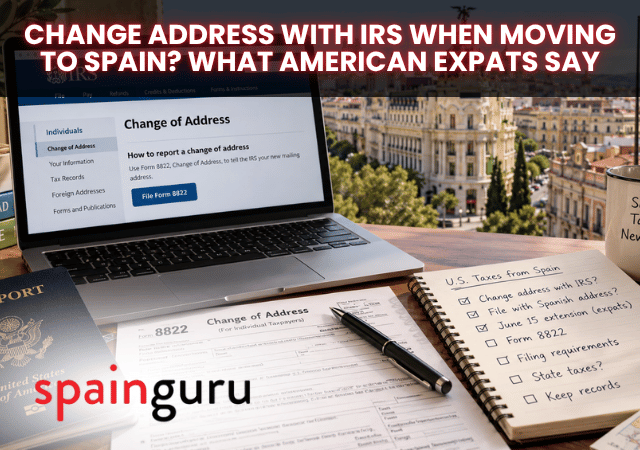
The IRS does have a dedicated change of address form, Form 8822. It is optional. The IRS also updates your address automatically when you file a return with your new address, and it uses the US Postal Service change of address database.
For most Americans moving to Spain, the community’s approach works: file your next federal return with your Spanish address and the IRS record updates itself. The main reason to change address with IRS earlier using Form 8822 is if you expect letters before your next filing, such as an open audit, a pending refund or an installment agreement.
Whatever you decide, keep a US bank account open for direct deposit of refunds, and make sure you can still receive IRS correspondence. Many expats use a US mail-scanning service or a trusted relative’s address for this.
Change Address with IRS: Filing Deadlines When You Live in Spain
The extension discussion in the thread is where most of the confusion lies, so here is how the rules work:
- Automatic 2-month extension. US citizens whose tax home and residence are outside the US on the regular due date get an automatic extension to June 15 to file and pay. You attach a statement to your return explaining that you qualify.
- Extension to October 15. If you need more time, file Form 4868 by June 15 to extend the filing deadline to October 15. A foreign address on last year’s return does not replace this request.
- Interest still applies. Any tax you owe accrues interest from April 15, even with an extension.
- No tax owed, no late-filing penalty. The failure-to-file penalty is calculated on unpaid tax, which is why members who owed nothing were not penalized. You still have a filing obligation, and refunds must be claimed within three years.
For a complete overview of these deadlines, plus FBAR, FATCA and what to sort out before you leave, see Settleguru’s complete tax guide for Americans living abroad.
Change Address with IRS and the Foreign Earned Income Exclusion
One member mentioned Form 2555. This is the Foreign Earned Income Exclusion (FEIE), and it is useful for Americans working in Spain, including Digital Nomad Visa holders. The limit is adjusted for inflation every year and is now well above the $100k mentioned in the thread.
The FEIE only covers earned income such as salaries and self-employment income. It does not cover pensions, Social Security, dividends or rental income, which is why many retirees on the Non-Lucrative Visa rely on the Foreign Tax Credit instead of the FEIE and the US-Spain tax treaty instead.
Once you live in Spain you will also have US reporting duties such as the FBAR for foreign bank accounts, alongside new Spanish obligations. Spainguru’s guide to taxes in Spain for expats explains Spanish tax residency, IRPF, Modelo 720 and how the US-Spain treaty fits in.
Beyond the IRS: State Taxes, Social Security and the State Department
The IRS is not the only US agency that cares where you live. The thread raised three others worth adding to your moving checklist:
- Your state tax authority. Some states keep treating you as a resident until you prove you have left, and California is known for contesting departures. Filing a final part-year return and keeping evidence of your move can avoid letters like the one a member received.
- Social Security. If you receive benefits, report your new address to the Social Security Administration directly. Changing your address with the IRS does not update Social Security records.
- The State Department. Enrolling in the Smart Traveler Enrollment Program (STEP) is optional and has nothing to do with taxes, but it lets the US Embassy in Madrid contact you in an emergency.
Change Address with IRS: Getting Professional and Free Help
US and Spanish tax rules overlap in ways that are easy to get wrong in your first year. Spainguru hosts free tax and financial planning webinars every month, where you can ask your own questions live. See the schedule and register on the Spainguru webinars page.
If you would rather have an expert handle your filings, Spainguru’s list of the best tax advisors for US and Spanish filings includes specialists in US expat returns, FBAR and FEIE, as well as Spanish tax advisors for IRPF and Modelo 720. Some of them offer discounts to the Spainguru community.
Change Address with IRS: Conclusion
The community’s answer is clear: you do not need to change address with IRS before moving to Spain. Your next federal return, filed with your Spanish address, updates your record, and sending a separate form early can sometimes create more confusion than it solves.
What matters more is getting the deadlines right. You get an automatic extension to June 15 while living abroad, but you still need Form 4868 to reach October 15. Also check whether your state still considers you a resident, and update Social Security directly if you receive benefits.
Start planning your move with Spainguru’s Moving to Spain guide, and explore Spainguru’s recommended NLV related services for legal help, health insurance and tax advice.
Join the American Expats in Spain Facebook group to ask your own questions about US taxes after the move. For more community channels, visit the Spainguru Community Hub.
This article is based on personal opinions from the Spainguru community and is not legal or tax advice. For professional guidance, consult one of the experts listed on Spainguru’s services page.
Change Address with IRS: FAQ
Do I have to change address with IRS when I move to Spain?
No. The IRS updates your address when you file your next return with your Spanish address. Form 8822 is optional and mainly useful if you expect IRS letters before your next filing.
How do I change my address with the IRS?
You can use your new address on your next tax return, submit Form 8822, or notify the IRS in writing. The IRS also uses the US Postal Service change of address database.
What is the tax filing deadline for Americans living in Spain?
Americans living abroad on April 15 get an automatic extension to June 15 to file and pay. You can extend to October 15 by filing Form 4868 by June 15, but interest on any tax owed runs from April 15.
Is there a penalty for filing late if I owe nothing?
The failure-to-file penalty is based on unpaid tax, so if you owe nothing there is usually no penalty. You still have a legal obligation to file, and refunds must be claimed within three years.
Does the Foreign Earned Income Exclusion apply to retirees?
No. The FEIE only applies to earned income. Pensions, Social Security and investment income are not covered, so retirees usually rely on the Foreign Tax Credit and the US-Spain tax treaty.
Do I need to tell Social Security that I moved to Spain?
Yes, if you receive benefits. Social Security keeps its own records, so report your new address to the Social Security Administration directly. Changing your address with the IRS does not update it.
Get your free step-by-step Spain move plan
10 emails over 2 weeks covering visas, budget, housing & the mistakes to avoid.
Free, from the team behind a community of 225,000+ expats.
100% free · No credit card · Unsubscribe anytime