


The Spain Non-Lucrative Visa (NLV) lets non-EU citizens live in Spain without working. In 2026 you need to show €28,800 a year (€2,400 a month) for the main applicant, plus €7,200 a year (€600 a month) for each family member, qualifying health insurance, and you apply at the Spanish consulate for where you live.
- €2,400a month, main applicant
- +€600a month per family member
- 1 + 2 + 2years: first permit, then renewals
- No workin Spain, employed or self-employed
Amounts: 400% of the IPREM (€600 a month in 2026) for the main applicant, 100% per family member, set by Royal Decree 1155/2024, article 62.
This guide is general information, not legal or tax advice. Consulates apply the rules differently and they change often: check your consulate’s current list and, for your own case, speak to a qualified professional.
Some services linked on this page are Spainguru partners. They pay Spainguru a listing fee or a commission when you hire them; this never changes your price. How we choose partners
Keep your NLV documents and deadlines organised
The Spainguru NLV Tracker gives you a document checklist for your Spanish consulate, helps you plan when to request time-sensitive documents based on the consulate’s published requirements and your appointment date, and sends you email reminders. Use it yourself or alongside your lawyer.
See my NLV checklist →Free to start. Requirements can change: always confirm with your consulate.
1What is the Spain Non-Lucrative Visa?
The Non-Lucrative Visa is a residence permit for non-EU citizens who want to live in Spain without any professional or economic activity here. People often call it the “retirement visa”, but it is open to anyone who can support themselves from savings or passive income.
It is the most common route for Americans, Brits, Canadians and Australians who want the Spanish lifestyle. The one rule you can’t bend: you cannot work for a Spanish company or run a business in Spain while you hold it. If your plans change later, you can modify your NLV into a work permit.
Quick eligibility check
- You are a non-EU citizen.
- You have enough passive income or savings: 400% of the IPREM, €28,800 a year for one person.
- You won’t work in Spain.
- You can meet the criminal-record requirements, with certificates from the countries where you lived in the last 5 years.
- You have qualifying health insurance and no disease with serious public-health implications.
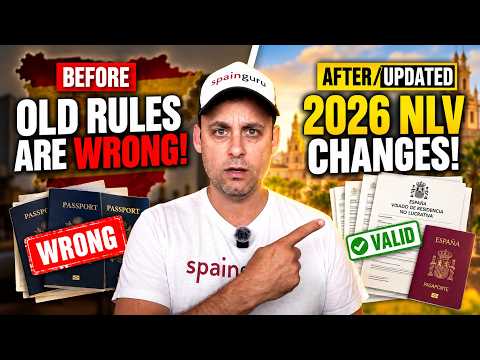
Watch
Spain’s NLV got updated: everything you missed
The rules changed several times in the last year. This video walks through the 2026 requirements, what’s new, common denial reasons, the 183-day tax trap and the 5-year path to long-term residence.
2Eligibility and financial requirements (2026)
The financial threshold is the heart of the NLV. Spain sets it as a percentage of the IPREM, a public income index that is €600 a month in 2026.
| Who | Share of IPREM | Per month | Per year |
|---|---|---|---|
| Main applicant | 400% | €2,400 | €28,800 |
| Each family member | 100% | €600 | €7,200 |
| Example: couple | 500% | €3,000 | €36,000 |
| Example: family of four | 700% | €4,200 | €50,400 |
Royal Decree 1155/2024, article 62. IPREM 2026: €600 a month (12 payments).
You can prove it with passive income (pensions, dividends, rental income) or with savings that cover the whole period, and many consulates accept a mix. Consulates are wary of income that depends on active work, including remote work.
How much do you need to show?
Monthly passive income
€2,400
or savings for the period
€28,800
1 person · 400% of the IPREM
Reaching the number is not enough on its own
The consulate also judges how you document the money: account history, where the funds come from and whether they are available to you. Follow your consulate’s list exactly.
More on financial proof
Questions about your numbers? Ask them live at the free NLV webinar →
Keep your NLV documents and deadlines organised
The Spainguru NLV Tracker gives you a document checklist for your Spanish consulate, helps you plan when to request time-sensitive documents based on the consulate’s published requirements and your appointment date, and sends you email reminders. Use it yourself or alongside your lawyer.
See my NLV checklist →Free to start. Requirements can change: always confirm with your consulate.
3Required documents checklist
Preparation is everything: one missing apostille can delay your move by months. This list combines what Spanish consulates in the US, UK, Canada and Australia publish with what our community has been asked for.
Requirements vary by consulate
Los Angeles may ask for documents London doesn’t, and the other way round. Always follow the list of the consulate for where you live. Find your consulate →
- 1
National visa application form
One form per applicant, every section filled in and signed. Some consulates, such as Washington DC, insist on specific sections (address, email, phone, intended entry date and address in Spain).
- 2
EX-01 form (residence authorisation)
The Solicitud de Autorización de Residencia Temporal No Lucrativa, completed and signed. Some consulates want the original plus a copy, others two originals. How to fill in the EX-01, step by step →
- 3
Passport-size photos
Recent colour photos on a white or light background, facing forward, nothing covering your face. Most consulates ask you to glue one to the application form.
- 4
Valid passport
At least one year of validity left and two blank pages; bring the original and a copy of the data pages. Some consulates have refused passports issued more than 10 years ago even when they had not expired, so if yours is that old, renewing it first avoids the risk.
- 5
Proof that you live in the consular district
A state ID, driver’s licence or equivalent showing your address in that consulate’s area; temporary licences are usually not accepted. Non-US citizens applying in the US also need proof of legal US residence (Green Card or long-term visa); tourist-visa holders must apply from their home country.
- 6
Criminal record certificate (apostilled and translated)
From every country where you lived in the last 5 years. It must usually be issued within the last 6 months, but some consulates ask for less (Melbourne, for example, has asked for 3 months), so check yours.
- United States: only the FBI certificate is accepted, with a federal apostille from the US Department of State, plus a sworn Spanish translation. Don’t remove staples or damage the original. How to get a federal apostille →
- United Kingdom: an ACRO certificate with a Hague apostille and a sworn translation.
- Other countries: apostilled under the Hague Convention, or legalised through the foreign ministry and the Spanish consulate if the country isn’t a signatory.
- 7
Medical certificate
Signed by a licensed physician (some US consulates don’t accept nurse practitioners or physician assistants), stating you have no disease with serious public-health implications under the 2005 International Health Regulations. Usually issued within 90 days of applying, with the doctor’s signature, licence number and stamp or letterhead, and a sworn translation unless you use the consulate’s template. UK consulates may require an apostille when a UK doctor signs it. Get your medical certificate →
- 8
Proof of financial means
Enough to support yourself and any family members for the whole permit without working: €28,800 a year for the main applicant plus €7,200 per family member in 2026. Typically:
- Bank statements for the last months from every relevant account.
- Bank certificates (with sworn translation) showing the account holder, opening date and balances; requested formats vary by consulate.
- Pension, Social Security, annuity or dividend statements showing the income continues.
- Your latest tax return.
Consulates differ here more than anywhere
- Washington DC asks for a notarised affidavit (in Spanish or translated) on your background, reasons for moving, length of stay, first address in Spain and a commitment not to work, remote work included.
- Los Angeles asks working-age applicants for an employer termination letter or a notarised commitment not to work, and has asked about outstanding loans or mortgages in the US.
- New York and London are less specific but expect the same level of proof.
- 9
Health insurance
Public or private cover from an insurer authorised in Spain, for the whole permit, with clear start and end dates. Private policies generally need full cover with no co-payments, deductibles, waiting periods or limits; travel insurance is refused. What else is required depends on the consulate: London accepts an S1 registration for eligible UK pensioners, and Miami says repatriation cover is not needed. Details in section 4.
- 10
Fee (form 790-052)
Two signed copies of form 790, code 052, ticking Autorización inicial de residencia temporal; some consulates take online payment, others a money order at the appointment. How to fill in and pay Modelo 790 →
The consulate’s visa fee is separate and depends on your nationality. Illustrative fees at the Spanish Consulate in Washington DC (2026, in US dollars): US citizens about $140, UK citizens about $691, Canadians about $789, Australians about $313, most other nationalities about $106, and about $13 for the residence authorisation. Fees are not refunded; confirm yours before the appointment.
- 11
Documents for family members
Each family member needs their own set of the documents above, plus:
- Marriage, registered-partnership or birth certificates, apostilled and translated (some consulates want them issued in the last 6 months).
- Spouses and registered or stable partners, and minor children, can join; adult children only in limited cases (for example, when they can’t support themselves for health reasons).
- Unregistered partners (Washington DC): proof of at least one year together, or children in common and cohabitation.
US and UK consulates: key differences
| Requirement | US consulates | UK consulates |
|---|---|---|
| Criminal record | FBI certificate only | ACRO certificate |
| Apostille | Federal (US Department of State) | Hague apostille |
| Notarised affidavit | Required in DC and LA | Not usually |
| Proof of accommodation | Advisable (DC) | Not usually |
| S1 instead of private insurance | Not applicable | Accepted (London, eligible pensioners) |
| Visa fee for own citizens | About $140 | About $691 |
| Termination or no-work letter | Advisable for working age (DC, LA) | Not usually |
Fees from the Washington DC consulate’s 2026 table; check your consulate.
More on background checks and apostilles
Need sworn translations or apostilles?
A translation error can cost you months. Compare sworn translators and apostille services our community uses. Compare sworn translators → Apostille services →
4Health insurance requirements
Travel insurance and most global expat plans don’t work for the NLV. You need cover for the whole permit from an insurer authorised in Spain, equivalent to the Spanish public system.
- No co-payments (copagos), deductibles or coverage limits.
- No waiting periods (carencias): full cover from day one.
- Consulate extras: some ask for repatriation cover, others (Miami, for example) say it isn’t needed. Follow your consulate.
- Public cover: most new applicants can’t rely on Spanish public healthcare for the visa, so they buy private cover. Applicants with qualifying public cover, such as eligible UK S1 holders, may be able to use it instead, depending on the consulate.
The most common timing question is when the policy should start. To compare providers, read about public vs private healthcare in Spain, reviews of Mapfre and Caser, and which insurers NLV applicants chose.
Need a visa-compliant policy?
A non-compliant policy is the most common reason NLV applications are refused in our community. Compare policies built for Spanish visas. Compare health insurance →
5Step-by-step application process
From the first document to the visa in your passport, plan for 4 to 6 months.
- 1
Gather your documents Months 1–3
Start with the criminal record check and its apostille: they take longest.
- 2
Book your appointment Around month 2
Consulates such as Miami or London book up weeks ahead; several US consulates use BLS.
- 3
Submit at the consulate Around month 4
In person, with your physical folder and the fee.
- 4
Wait for the decision 1–3 months
Processing varies by consulate. Once approved, you have one month to collect the visa.
- 5
Enter Spain and get your TIE First month in Spain
Apply for your residence card (TIE) within one month of arriving.
More on timing
Want a walk-through of the whole process? Join the free NLV webinar →
6Spanish consulates: why your location matters
A “yes” in New York can be a “maybe” in Los Angeles. The law is national, but each consulate decides how you prove income, how many statements it wants and how appointments work. Follow the consulate for where you live. Each page below collects the latest first-hand experiences from our community.
Also covered: Mexico · Argentina · Philippines · United Arab Emirates
Not sure which consulate is yours? Find your Spanish consulate in any of our 8 countries →
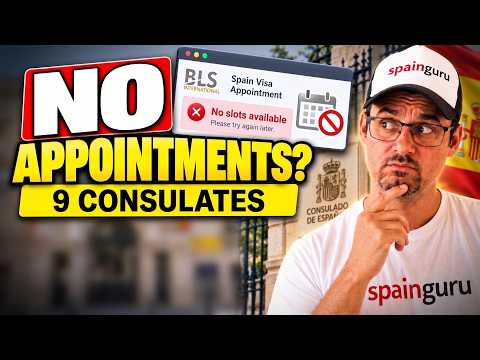
Watch · all 9 US consulates
The consulate appointment lottery: 9 US consulates, 9 systems
Six consulates route the NLV through BLS and three take it directly. Chapters jump to each one. Built from 100+ first-hand community reports.
7Do you need a lawyer?
Many people prepare the NLV themselves. A lawyer is worth it for complex cases: families with several dependents, mixed income sources, a previous refusal or an unusual consulate. See what our community did in the NLV lawyer vs DIY poll.
Speak with an immigration lawyer
Compare English-speaking immigration lawyers vetted by Spainguru who handle NLV applications, renewals and family cases.
8NLV costs breakdown (estimated)
Two different things: the money you must show (not a fee, see section 2) and what the process costs. Here is a 2026 estimate for one applicant.
| Item | Estimated cost |
|---|---|
| Consulate visa fee (US citizen) | €80 – €140 |
| Translations and apostilles | €300 – €600 |
| Health insurance, per person per year | €700 – €1,800 |
| Total if you do it yourself | €1,080 – €2,540 |
| Lawyer (optional) | €800 – €2,500 |
| Total with a lawyer | €1,880 – €5,040 |
Estimates for one US applicant, not quotes. Fees for other nationalities are in section 3, item 10; services vary by provider, age and documents.
After the move, budget for the health insurance renewal each year, plus living costs and Spanish tax once you are resident. Full NLV cost breakdown →
9After approval: your first steps in Spain
You have the visa in your passport; now the paperwork in Spain starts.
- Empadronamiento: register your address at the town hall with your rental contract or deeds. Many offices ask for it at the TIE appointment.
- TIE: apply for your residence card within one month of arriving, with a cita previa at the police station.
- Bank account: for utilities and local taxes. Compare financial services →
First steps after arriving in Spain → · Check your lote number after fingerprints · Is your TIE ready for pickup?
10Renewal and the path to long-term residence
The first permit lasts one year (the visa sticker is now issued for the full year: what the one-year validity means). After that you renew for two years, and again for two. After 5 years of legal residence you can apply for long-term residence, which lets you work. A job offer can let you switch earlier: from NLV to a work permit.
- When: in the 60 days before your permit expires, or up to 90 days after (late applications can be fined).
- Money: for a two-year renewal most offices ask you to show funds for the whole period (€57,600 for one person); some provinces ask for one year only.
- Also: health insurance without gaps for the new period, and no criminal record.
The 183 days and your renewal: the May 2026 Supreme Court ruling
Article 64.2.f of Royal Decree 1155/2024 asks NLV holders to have lived in Spain more than 183 days a year to renew. According to immigration lawyer Ainhoa Manero (Sterna Abogados), the May 2026 Supreme Court ruling means a minimum stay set only in the regulation, not in the law, cannot be used to refuse a renewal: you can renew after more than 183 days abroad if you meet the other requirements (funds and health insurance). Her interpretation applies the Supreme Court’s reasoning to NLV renewals, although the judgment concerned a different residence regime and did not expressly annul article 64.2.f.
Immigration offices may not follow this interpretation yet, so a refusal may need to be challenged through an administrative or court appeal, and earlier refusals should be reviewed individually by a lawyer. Some lawyers read the ruling more narrowly: get advice on your own case before planning long absences. Full analysis →
Watch
The 183-day ruling explained by an immigration lawyer
Bruno asks Ainhoa Manero (Sterna Abogados) who benefits, what immigration offices are doing and what it means for long-term residence and citizenship.

Renewal is not the same as tax or citizenship
Spending more than 183 days a year in Spain generally makes you a Spanish tax resident, whatever the renewal rules say. And citizenship requires legal and continuous residence: immigration lawyer Ainhoa Manero recommends keeping absences below about 90 days a year as a prudent guideline. It isn’t a fixed legal allowance; the authorities look at how often, how long and why you were away. Spanish citizenship in 2026 →
NLV renewal experiences and rules
Renewing soon? Ask in the NLV Renewals group →
11Tax implications of the NLV
The tax side is the most overlooked part of the NLV. Spending more than 183 days in Spain in a calendar year generally makes you a Spanish tax resident, but your centre of economic interests, where your spouse and minor children live and tax treaties can also decide it. Spanish tax residents are generally taxed on their worldwide income, subject to exemptions and tax treaties: US Social Security, UK pensions, dividends and rent from abroad.
- Modelo 720: an information return on assets abroad. The €50,000 threshold applies separately to three groups: bank accounts; securities, insurance and annuities; and real estate.
- US citizens: you stay subject to US filing rules while living in Spain and, depending on your income, may need to file in both countries. The US–Spain treaty and foreign tax credits help prevent double taxation.
- Beckham Law: not for NLV holders. Retirees and people who don’t work in Spain aren’t eligible; the regime is for people who move to Spain to work and meet its conditions.
- Wealth tax: charged on net assets, with thresholds and rates that vary by region.
Get advice before you move, not at your first tax return: many NLV holders in our community were surprised by their first Spanish tax bill. How Spain taxes pensions and savings →
Need a tax expert?
Compare advisors vetted by Spainguru who cover Spanish obligations and US or UK filings. Compare tax experts →
12NLV for families and dependents
Your spouse or registered or stable partner and your minor children can apply with you. Adult children qualify only in limited cases, such as when they can’t support themselves for health reasons.
- Money: 400% of the IPREM for you plus 100% per family member. A family of four needs €4,200 a month (€50,400 a year).
- Documents per person: each family member needs their own forms, photos, medical certificate, health cover and, from 18, criminal record certificate. A family policy can cover everyone if it meets the requirements.
- Certificates: marriage and birth certificates apostilled and with sworn translation; not every consulate recognises every type of partnership.
- Nobody works: the NLV doesn’t allow work for any family member.
- Schools: children can attend Spanish public schools; you’ll need the empadronamiento to enrol.
Family applications have more points of failure: one missing document for one person can hold up everyone. Consider professional help.
13Common mistakes to avoid
- Insurance with co-payments: the most common reason for refusals in our community. Find compliant insurance →
- Out-of-date criminal record: usually it must be issued within the last 6 months, and some consulates ask for less.
- Thin account history: not showing enough months of statements.
- Wrong translations: use a sworn translator (traductor jurado) recognised by the Spanish Ministry of Foreign Affairs. Find a sworn translator →
- Assuming every consulate is the same: requirements, appointments and timing differ.
- Ignoring taxes: many applicants don’t realise they’ll become Spanish tax residents.
14What if your NLV is denied?
- Read the reason: the written decision says why (funds, documents, insurance).
- Appeal: you can file a recurso de reposición within one month of the notification. It’s a formal process; a lawyer improves your chances.
- Reapply: if the problem can be fixed (wrong insurance, missing apostille), fix it and apply again. There’s no formal waiting period.
- Moving consulate: changing your legal residence to another consulate’s district is legal, but it must be genuine and takes planning.
In our community the top reasons are non-compliant health insurance, weak financial proof and expired or wrongly apostilled documents. NLV denials and appeals, step by step →
15Switching to the Digital Nomad Visa, and remote work
The NLV doesn’t allow any work in Spain; the Digital Nomad Visa (DNV) is for remote workers. They are different permits, so you can’t simply convert one into the other.
- From inside Spain: as of October 2026, NLV-to-DNV applications made in Spain are being refused in practice, and those refusals are being fought in the courts. Don’t count on it.
- From a consulate abroad: the route that works today. You apply for the DNV at a Spanish consulate and enter on the new visa, meeting all DNV requirements (remote work, 200% of the Spanish minimum wage, health insurance). It can leave a gap in your residence timeline.
- After 5 years: long-term residence lets you work without restrictions.
Can you work remotely on the NLV?
The NLV does not authorise employment or professional activity in Spain. A 2012 Supreme Court ruling is often cited to argue that remote work for foreign clients is allowed, but consulates such as Los Angeles state that the NLV doesn’t allow remote work and refuse clear remote-worker profiles. Don’t rely on the NLV to telework: if you work remotely, the DNV is the right route. The 2012 ruling and remote work, explained →
16NLV vs other visa options
| NLV | Digital Nomad (DNV) | Student | |
|---|---|---|---|
| Can you work? | No | Yes, remote | Part-time, up to 30 h a week, with conditions |
| Income needed (2026) | €2,400 a month | About €2,850 a month | €600 a month |
| Long-term residence | After 5 years | After 5 years | Depends on your case |
| Citizenship | 10 years of residence (2 for some nationalities*) | 10 years of residence (2 for some nationalities*) | Depends on your case |
| Beckham Law | No | Potentially, if you qualify | No |
* Nationals by origin of Ibero-American countries, Andorra, the Philippines, Equatorial Guinea or Portugal, and qualifying Sephardic applicants, can apply after 2 years of legal and continuous residence: see the 2-year citizenship route guide. DNV: 200% of the 2026 minimum wage (€1,221 × 14 ÷ 12). Student: 100% of the IPREM.
The 2-year citizenship route → · Not sure which visa fits? Explore all visa options and services →
Spain Non-Lucrative Visa webinar, with live Q&A
Live sessions with Bruno · 15:00 CET · every registrant gets the recording
The full requirements checklist, how to present your financial proof, real cases and the latest consulate changes, with your questions answered at the end. Focused on US and UK applicants, useful for Canada, Australia and beyond.
Missed the last one? See all webinars and recordings
Recording of the 16 September 2026 session
Essential services for your NLV
Health insurance
Visa-compliant policies with no co-payments or waiting periods.
Compare Insurance →Medical certificate
The doctor’s certificate your consulate asks for.
Get Your Certificate →Sworn translators
Translations recognised by Spain’s Ministry of Foreign Affairs.
Find a Translator →Immigration lawyers
English-speaking lawyers for applications, renewals and appeals.
Find a Lawyer →Apostille services
Apostilles for US and UK documents.
Get an Apostille →Tax experts
Spanish tax plus US or UK filings.
Find Tax Help →Frequently asked questions
What is the non-lucrative visa and how does it work?
A Spanish residence permit for non-EU citizens who want to live in Spain without working. You prove enough passive income or savings (400% of the IPREM, €28,800 a year for one person in 2026) and qualifying health insurance, and apply at the Spanish consulate for where you live.
How much income do I need for the NLV in 2026?
€2,400 a month (€28,800 a year) for the main applicant, plus €600 a month (€7,200 a year) for each family member. It must come from passive sources such as pensions, dividends, rent or investments, or from savings.
Can I show savings instead of income?
Yes. Savings that cover the period of the permit work: €28,800 for one person for the first year, plus €7,200 per family member. For a two-year renewal most offices ask for two years of funds; some provinces ask for one. Many consulates accept a mix of income and savings.
Can I work remotely on the NLV?
No. The NLV doesn’t authorise employment or professional activity in Spain, and consulates such as Los Angeles say it doesn’t allow remote work. If you work remotely, the Digital Nomad Visa is the right route.
Can I switch from the NLV to the Digital Nomad Visa?
Not reliably from inside Spain: as of October 2026 those applications are being refused in practice and the refusals are being fought in court. The route that works is applying for the DNV at a Spanish consulate abroad.
Do I still need to spend 183 days a year in Spain to renew my NLV?
According to immigration lawyer Ainhoa Manero (Sterna Abogados), after the May 2026 Supreme Court ruling the 183-day minimum, set only in the regulation, can’t be used to refuse a renewal, as long as you meet the funds and health insurance requirements. Offices may not apply it yet and a refusal may need an appeal, so get advice on your case. 183 days still matters for tax residency.
Do I become a Spanish tax resident with an NLV?
Generally yes if you spend more than 183 days in Spain in a calendar year, and economic or family ties or a tax treaty can also make you resident. Tax residents declare worldwide income, including pensions, dividends and rent from abroad.
Can my spouse work on a dependent NLV?
No. Nobody in an NLV household can work in Spain.
Can I buy property in Spain with an NLV?
Yes. Owning property is allowed, but it doesn’t give you residence or replace the income requirement.
How long does the NLV application take?
Usually 4 to 6 months from gathering documents to the visa. Consulates typically decide in 1 to 3 months after you submit, and busy ones (Miami, Los Angeles, New York, London) can take longer. After arrival you apply for the TIE within one month.
Can I get Spanish citizenship with the NLV?
After 10 years of legal residence, or 2 years for nationals by origin of Ibero-American countries, Andorra, the Philippines, Equatorial Guinea or Portugal, and qualifying Sephardic applicants. You must pass the CCSE (and DELE A2 if Spanish isn’t your native language) and show legal and continuous residence; immigration lawyer Ainhoa Manero recommends keeping absences below about 90 days a year as a prudent guideline, though it isn’t a fixed legal allowance. Spain also has nationality-renunciation rules; what they mean for your other nationality depends on that country’s law, so get specialist advice. More in our guides to Spanish citizenship in 2026 and the 2-year citizenship route.
More NLV and moving resources
Latest NLV experiences and updates
Real applications from our community, newest first.
-

Spain Non Lucrative Visa San Francisco – Firsthand Experience September 2026
Last Updated on November 11, 2026 by Bruno Bianchi This article is based on a real firsthand experience shared by a Spainguru community member: a family of four…
-

Spain Non Lucrative Visa San Francisco – Retired Couple Firsthand Experience July 2026
Last Updated on October 30, 2026 by Bruno Bianchi This article is based on a real firsthand experience shared by a Spainguru community member who applied for the…
-

Spain Non Lucrative Visa Edinburgh – Firsthand Experience July 2026 (Approved in 12 Days)
Last Updated on October 30, 2026 by Bruno Bianchi This article is based on a real firsthand experience shared by a Spainguru community member who applied for the…
-

BLS San Francisco Appointment: When Slots Open and How to Book One (2026)
Last Updated on October 30, 2026 by Bruno Bianchi Getting a BLS San Francisco appointment for the Spain non lucrative visa is the hardest step of the whole…
-
Spain Non Lucrative Visa Renewal Granada – Firsthand Experience September 2026 (Year 4/5 Approved in 3 Days)
Last Updated on October 30, 2026 by Bruno Bianchi This article is based on a real firsthand experience shared by a Spainguru community member whose Spain non lucrative…
-

Spain Non Lucrative Visa Boston – Firsthand Experience August 2026 (Approved in 20 Days)
Last Updated on October 30, 2026 by Bruno Bianchi This article is based on a real firsthand experience shared by a Spainguru community member who applied for the…