Last Updated on October 13, 2026 by Bruno Bianchi
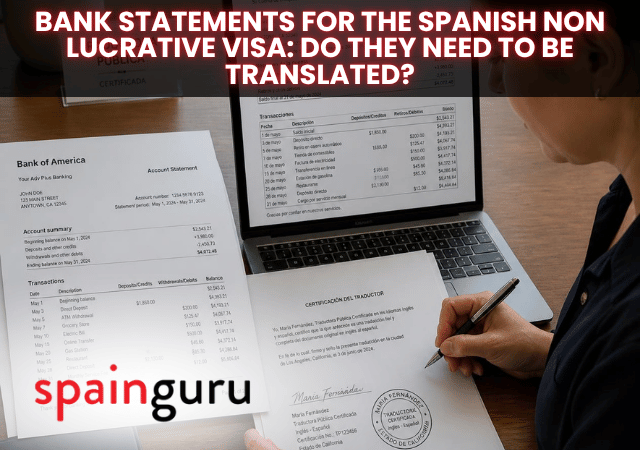
Short answer: in most cases you do not need to translate the bank statements themselves for the Spanish non-lucrative visa (NLV). What consulates do expect in Spanish is the bank letter or certificate that summarises your accounts. There is one documented exception (Melbourne), and some official checklists are worded in a way that suggests otherwise, which is why this question keeps coming up in our Spanish Non Lucrative Visa group.
This guide puts together what the regulation actually says, what the consulate checklists say, and what applicants reported first-hand in 2024, 2025 and 2026, so you can decide what to translate and what not to pay for.
Planning your move to Spain?
Get the free step-by-step roadmap — covering visas, budget, housing, and the mistakes to avoid.
Start the Moving to Spain Hub →Why the official checklist and real experience disagree
The San Francisco consulate’s checklist asks for an “official translation” of the financial documents. Yet five different members who applied through San Francisco between 2025 and 2026 told us the same thing: nobody asked for translated statements. They submitted the bank letter in Spanish and the statements in English, and the visas were approved. One of them had already spent 2,600 USD translating 30 pages of statements that were never looked at.
That is the pattern you will see below for most consulates: the written list is the maximum they may ask for; the practice is narrower. It does not mean the list is wrong, and it does not mean you can ignore it. It means you should find out which documents your consulate actually wants in Spanish before paying for translations.
Two sensible ways to do that: ask the consulate or BLS centre in writing whether the “official translation” requirement covers the statements or only the bank letter, or bring the bank letter translated and the statements untranslated, and translate the statements afterwards only if they are requested.
What the regulation says (and does not say)
Article 62.3 of Royal Decree 1155/2024, the current Spanish immigration regulation, deals with proof of funds for the non-lucrative residence permit. It says that the availability of funds “may be proven by any means of proof admitted in law”, and that information about accounts held abroad must include:
Need a medical certificate for your visa?
Get a bilingual medical certificate prepared for Spanish visa applications, or see how to get one from a doctor in Spain.
Get Your Medical Certificate →- the full name and address of the bank or credit institution;
- the complete identification of the accounts;
- the opening (or closing) date of each account;
- the balance at 31 December of the previous year and the average balance over the last year.
Nothing in that article mentions translation. The translation requirement, where it exists, is consular practice, not a legal rule, which is exactly why it varies from one consulate to another and why the bank letter matters so much: it is the document that carries the four pieces of information the regulation asks for.
What to translate: the bank letter, not the statements
If you translate one thing, make it the bank letter or bank certificate. It is one or two pages, it contains the account identification, opening date, current balance and 12-month average that the regulation lists, and a sworn translation (traducción jurada) of it is cheap compared with translating dozens of pages of transactions. What that certificate must say, and what to do if your bank will not issue one in this format, is covered in what the NLV bank certificate must contain and in proof of funds: bank certificates and accepted alternatives.
Other documents that do need a sworn translation for the NLV are the criminal record certificate and the medical certificate (when not issued bilingually). See our list of documents that require sworn translation for the NLV.
If a consulate does ask for translated statements, a sworn translator will translate everything, not just the summary pages. In the words of a Spanish immigration lawyer interviewed by Spainguru:
“I always translate them because I don’t want the approval to be delayed. It is true that sometimes it’s very clear, but it’s not the first time the consulate has asked me to translate them. I do translations of the full documents, not just the summary pages but everything.”
That is the cautious professional position: a lawyer handling many files would rather pay for translations than risk a delay. For an individual applicant with a 30-page statement, the arithmetic is different, which is why it pays to ask first.
What applicants reported, consulate by consulate
These are first-hand reports from our community, grouped by consulate or BLS centre. Consular practice changes without notice, so treat them as what happened to real applicants on a given date, not as a guarantee. The most recent reports are from the September 2026 discussion in the group.
| Consulate / BLS | Statements translated? | What was asked for |
|---|---|---|
| San Francisco (2025–2026) | No (5 reports) | Bank letter in Spanish; statements in English accepted. One applicant was also asked for a separate notarised and translated letter stating they will not work in Spain. |
| Houston (2026) | No | Bank letters yes; statements no. |
| Washington DC (2024) | No | Three months of cover pages, no translation; same documents later accepted for the year 2–3 renewal. |
| BLS London (2024) | No | Printed, downloaded statements accepted; not stamped, not translated. |
| Edinburgh (2024) | No | Twelve months of printed statements accepted without translation. |
| Hong Kong (2026) | No | Only the bank reference letter. |
| Bogotá (2026, via lawyer) | No | Only the bank letters. |
| Melbourne (2026) | Yes | Statements translated by a sworn translator. |
A 2025 poll in the group points the same way: of 80 applicants who answered, 77 % did not translate their statements, 17 % translated only the summary pages, 3 % translated everything, and the rest obtained statements in Spanish or an official letter from their bank.
Melbourne is the reminder that “most” is not “all”. If your consulate is not in the table, ask in the group for recent first-hand experiences before deciding.
What it costs, and how not to overspend
Around 35 USD per page is a normal rate for a sworn translation into Spanish, not an abusive one. The problem is the number of pages: a year of statements from two or three accounts can run to 30 pages or more, which is how applicants end up quoted 1,000 to 3,000 USD. Members have reported paying 325 EUR for 12 pages of financial documents and 60 EUR for two FBI background checks. See our guide to sworn translation services and costs for current figures.
Ways to keep the bill down:
- Translate only the bank letter. It is the document that answers the regulation’s questions.
- Ask the consulate in writing whether translated statements are required before ordering anything.
- Check whether your bank can issue statements or a certificate in Spanish. Several international banks can.
- Switch your online banking to Spanish and print from there. Some members did this for the statements. Be aware that this is not a sworn translation and does not replace one where it is actually required.
- If you need to translate statements after all, ask whether the consulate accepts printed PDFs of the sworn translations rather than originals.
Apostille: not for bank documents
Bank statements and bank letters are not apostilled. An apostille certifies the signature on a public document (a criminal record certificate, a medical certificate, a marriage certificate); a bank statement is a private document and no consulate asks for it to be apostilled. Some applicants choose to have their statements notarised, and a few then apostille the notarised copy, as an extra layer of formality. That is a personal choice, never a requirement. Where a consulate checklist says “legalised or apostilled”, it is referring to the public documents, not to the bank paperwork.
Two things are often confused here: sworn translation (a translation by a translator certified by the Spanish Ministry of Foreign Affairs; this is what consulates want for documents in another language) and apostille (international legalisation of a public document). The bank letter may need the first; it never needs the second.
How many months of statements
This is a separate question from translation, and the answer also depends on the consulate. Three months is the common baseline for most US consulates (New York, Washington DC, Los Angeles, San Francisco, Boston); Houston, Miami, BLS Manchester and Edinburgh ask for twelve. Almost all of them also want the bank certificate with the balance at 31 December and the twelve-month average. “Six months” is community folklore: it does not appear on any official list. Full detail in how many months of bank statements you need, and if your accounts are online-only see how to provide bank statements from online accounts.
A trap from San Francisco worth knowing about
One applicant approved through San Francisco in 2026 was asked by BLS for a separate letter, notarised and translated, declaring that they will not work in Spain. Wording such as “I understand that…” or “I commit to…” inside the letter of intent was not accepted; they wanted an explicit, unambiguous declaration. If you include this commitment in your letter of intent, make it a plain statement, and be prepared to produce it as a standalone document.
What group members said
A selection of the answers that started this discussion, from members of the Spanish Non Lucrative Visa group:
“Bank statements don’t have to be translated. My husband had to show a letter regarding his private pension to confirm how much he got.”
“I did not translate the statements, but I did provide a table of contents with the titles of each account in English and Spanish along with the US dollar amounts and euro amounts for our total savings, retirement/investment accounts, and monthly income.”
“Three months of front page/cover sheets, no translations, no problem with the DC consulate. I just submitted the same to the Spanish government for our years 2/3 renewal.”
“I printed off my Nationwide statements for the last 12 months. Accepted in Edinburgh, no problem. No translation.”
“The requirement stated in the instructions is to translate everything. We translated everything via Google Translate and attached a spreadsheet of the details of deposits and transfers between accounts, with transaction descriptions in Spanish.”

Frequently asked questions
Do I need to translate my bank statements for the Spanish non-lucrative visa?
Usually not the statements themselves. Most consulates and BLS centres accept English statements, and what they do want translated is the bank letter or certificate (balance, average balance, account opening date). Melbourne is a known exception and asks for a sworn translation of the statements. Check your consulate’s current checklist and, if it says “official translation”, ask in writing whether that covers the statements or only the bank letter.
Does the law say bank statements must be translated?
No. Article 62.3 of Royal Decree 1155/2024 says sufficient funds can be proven “by any means of proof admitted in law” and lists what information about foreign accounts must be included (bank name and address, account identification, opening date, balance at 31 December and average balance over the last year). It says nothing about translation; that requirement, where it exists, comes from each consulate’s own practice.
Do bank statements need an apostille?
No. Bank statements and bank letters are private documents, not public ones, so they are not apostilled. Some applicants choose to have them notarised (and then apostille the notarised copy) as an extra layer of formality; that is a personal choice, never a consular requirement. Apostilles apply to public documents such as the criminal record certificate and the medical certificate.
How much does it cost to translate bank statements?
Sworn translators typically charge per page, and around 35 USD per page is a normal rate, not an inflated one. The problem is volume: 30 pages of statements at that rate is over 1,000 USD, and applicants have reported spending 2,600 USD on translations a consulate never asked to see. Translating only the bank letter usually costs a fraction of that.
How many months of statements do I need?
It depends on the consulate: three months is the common baseline (New York, Washington DC, Los Angeles, San Francisco, Boston), while Houston, Miami, BLS Manchester and Edinburgh ask for twelve. Almost all of them also want a bank certificate stating the balance at 31 December and the average balance over the last twelve months. “Six months” does not appear on any official list.
Conclusion
For the Spanish non-lucrative visa, translate the bank letter, keep the statements in English unless your consulate tells you otherwise in writing, forget about apostilling anything issued by a bank, and check how many months your consulate wants before you print. The regulation asks for four pieces of information about your accounts and nothing about language; the consulates fill in the rest, each in its own way.
If your experience differs from the table above, please share it in the group: it is the only way this page stays accurate for the next applicant.
Join our community!
Make sure to join our dedicated Spanish Non Lucrative Visa group here!
Disclaimer: this article is based on the Spanish regulation, consulate checklists and the contributions of Spainguru community members. It does not constitute legal advice. Consular procedures change; always check the current checklist of your consulate or consult a qualified immigration professional.
📖 Related reading: for a complete overview of requirements, application process, renewals and financial proof, see our Non-Lucrative Visa: The Complete Guide.
Get your free step-by-step Spain move plan
10 emails over 2 weeks covering visas, budget, housing & the mistakes to avoid.
Free, from the team behind a community of 225,000+ expats.
100% free · No credit card · Unsubscribe anytime