Spain’s immigration system is under unprecedented strain. For months, foreign residents across the country have faced endless delays, failed online booking attempts, and a bureaucratic deadlock that has left thousands unable to work, renew residence permits, or access basic rights. The frustration has now reached boiling point — and a national protest has been announced in Madrid to demand urgent reform of what many are calling Spain’s failed immigration appointment system.
Growing Crisis: The System That No Longer Works
The Spain immigration appointment system was designed to manage essential procedures — from obtaining or renewing residence permits to registering family reunifications or applying for long-term residency. However, it has become nearly impossible for many applicants to secure an appointment.
Reports show that individuals now wait weeks or even months just to access the online booking platform, which frequently displays the same discouraging message: “No appointments available.” According to immigration lawyer Pau Ventura, who has organized a national protest to demand reform, the system has “completely collapsed.”
Endless Waiting and Legal Uncertainty
In normal circumstances, Spain’s immigration offices should process applications within a reasonable timeframe, allowing residents to maintain legal status and employment. Instead, thousands of migrants now face months — and in some cases, over a year — of waiting.
Ventura explains that the issue is not limited to slow processing times but also the inability to even book an appointment in the first place. “The immigration system is totally collapsed. Many lives are on hold,” he stated, describing a situation in which people’s futures depend on a system that has stopped functioning.
The Human Cost: Jobs Lost and Lives Interrupted
The consequences of Spain’s broken appointment system are severe. Without valid residence permits or renewals, many foreign residents cannot sign employment contracts, enrol in healthcare, or register their children in school.
Employers, too, are affected. Job offers are being withdrawn because candidates cannot provide updated legal documentation. Families remain separated while waiting for reunification appointments that never come. For many, the collapse of the Spain immigration appointment system is not merely administrative — it is deeply personal.
A Peaceful Protest for Change
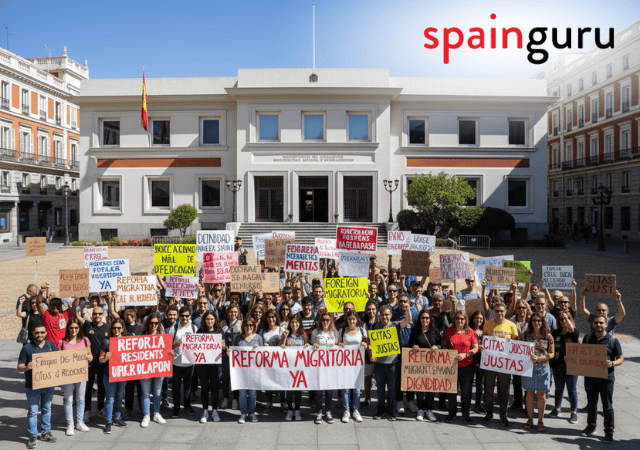
In response to this ongoing crisis, lawyer Pau Ventura has called for a national protest on Saturday, November 22 2025 at 11:00 a.m. outside the Ministry of Inclusion, Social Security and Migration in Madrid (Calle José Abascal 39).
The goal, Ventura explains, is not to criticize the civil servants working in overwhelmed offices, but to demand structural reform. “Officials are being blamed, but they are not the problem. The real issue is that the offices are not being reinforced,” he said.
His message is clear: “This is not a protest against officials. It is a demand for a dignified, efficient, and humane system.”
Why the Appointment Crisis Happened
Experts and trade unions agree that Spain’s immigration bottleneck stems from chronic underfunding and understaffing. Despite the rising number of foreign residents — now over 6.5 million — immigration offices have not received the resources necessary to manage the workload.
The pandemic intensified the problem, with backlogs that were never fully cleared. Many offices operate with limited staff, outdated systems, and inconsistent regional coordination. The result is a nationwide administrative paralysis affecting tens of thousands of legal residents.
What Can Be Done to Fix Spain’s Immigration Appointment System?
Professionals and advocacy groups have outlined several solutions to alleviate the crisis:
- Increase staffing and funding in immigration offices, especially in high-demand provinces such as Madrid, Barcelona, and Valencia.
- Modernize the online booking system, introducing real-time availability updates and digital queue systems.
- Decentralize certain immigration services to regional offices or external agencies to ease national backlogs.
- Simplify administrative processes for renewals and family reunification, reducing unnecessary documentation.
- Implement transparent communication channels, allowing applicants to track progress and avoid uncertainty.
Without such measures, legal experts warn, the system risks complete breakdown — leaving Spain’s image as an inclusive, modern country in jeopardy.
Legal and Social Consequences of the Collapse
Under Spanish and European law, foreign residents have the right to legal security and due process. Yet the current failure effectively denies them both. People who have complied with all legal requirements are being left in limbo, unable to prove their lawful residence.
This limbo not only harms individuals but also disrupts Spain’s labour market, as many qualified professionals — from healthcare workers to engineers — are prevented from working legally. The situation also undermines Spain’s commitments under EU migration policy and international human rights standards.
Voices from the Community
Community organizations across Spain have echoed Ventura’s call for reform. Migrant support groups in Andalusia, Catalonia, and the Valencian Community report identical problems: fully booked online systems, arbitrary cancellations, and unreachable phone lines.
Online forums and social media groups are filled with stories of residents refreshing the official website for hours — even days — without success. For many, this experience has become emblematic of Spain’s bureaucratic inefficiency.
Looking Ahead: Will Reform Come?
The November 22 protest aims to pressure the government into acknowledging the scale of the crisis and committing to immediate action. The Ministry of Inclusion, Social Security and Migration has not yet issued a formal statement addressing the planned demonstration.
Still, growing public attention and professional outcry may force political leaders to act. As Ventura emphasizes, “The change will not come by itself. We will make it happen.”
Conclusion: A Call for Dignity and Reform
Spain’s immigration appointment system is at a breaking point. What was once an administrative inconvenience has evolved into a national crisis affecting families, employers, and entire communities.
The upcoming protest in Madrid is a reflection of a broader demand: a fair, efficient, and humane immigration process. Without immediate reform, Spain risks alienating the very residents who contribute daily to its economy and cultural diversity.
For now, thousands wait — refreshing a website that rarely works — hoping for a system that once again respects their time, their effort, and their rights.