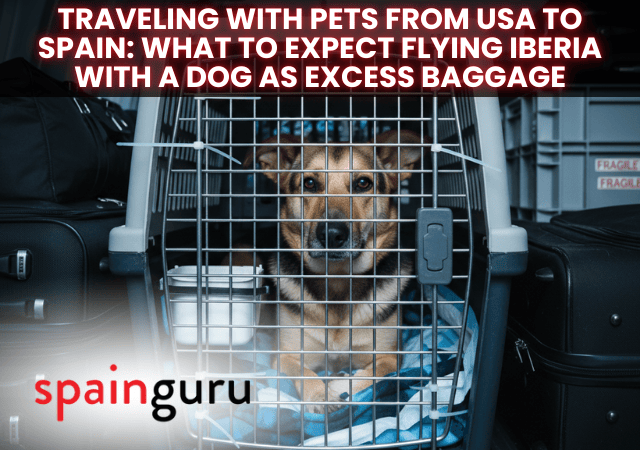
“I wanted to do a post about Traveling with pets from USA to Spain (Iberia airlines from LAX to Madrid) with our dog in hold to help others who might be moving to Spain with a dog too big to go in the cabin.
This is just our experience and our key takeaways:
1. Book your flight first and then call Iberia to add your dog as excessive baggage on your flight (make sure to check Iberia website for weight restrictions for your dog to go in hold as excessive baggage).
- Make sure you can see your dog added on your ticket. We could see he was added on their website under manage booking.
- At LAX we got a scare because they asked for his pet passport. We only had the USDA health certificate and rabies certificate.
They told us that in order to go in the hold he had to have the pet passport. They finally got someone else who accepted that because our dog had never been to the EU that he was fine to go without the pet passport.
In all of the research we had done we had never encountered that we might need a pet passport for him from the US to Spain. I’m not sure if we just got lucky or he didn’t really need one.
- They were all very friendly and helpful at LAX. We checked in 4 hours early but they didn’t let us take him after check in to walk around and bring back.
After checking us in and taking all of our baggage, they walked us to oversized baggage to wait for a TSA agent. They allowed Murphy to keep his collar on. His collar also had an AirTag attached.
The agent examined the crate and Murphy (just asked us to hold him up) and then we put Murphy back in the crate, added water to his bowl (we wanted to freeze the water ahead of time but we were in a hotel with no way of doing that), they zip tied it closed and off he went.
- When we got on our flight we asked the flight attendant to check to see if Murphy was on the plane and she told us he was but we could also track him with the AirTag.
- When we got into Madrid, we went through passport control, and then on to baggage claim. We weren’t sure where to pick up Murphy and an airline worker told us to check at the Iberia counter.
He was waiting there for us. The picture shows the red counter. It is right near El Mercado Duty free shop. Murphy was just hanging out waiting for us. Iberia didn’t ask us to show his paperwork at all. We just took his crate. We brought nail clippers to cut the zip ties. The zip ties were really thick and strong so we had to cut and twist to finally get them off the crate.
- If you have lots of luggage and a dog crate we recommend using straps to strap your luggage together.
We did this with 5 large luggages and 2 carry ons and we had 2 luggage “trains” plus a cart with Murphy and it made it much easier to move around the airport. The 2nd picture shows how we strapped the luggage together.
- We knew that Madrid has dog relief areas but we didn’t see any for arrivals so we just used an outside area that had some bushes and trees.
- Murphy did great the entire time and is a happy Spanish dog now in his new home!”
Check Spainguru’s recommended Pet transportation options.
Questions and Answers
“How many pounds is he? My girl is 40-43 lbs and a ball of nerves. I’m always wondering how I’d move her.” – “He’s 35 pounds. Our dog is pretty chill. I hope you’re able to move her without it being too stressful.”
“What is allowed inside the crate? A small fuzzy pad? A favorite small blanket or just nothing?” – “I always put in a fluffy blanket. They usually do ask that you put something absorbent in there so that if they pee it doesn’t go everywhere.”
“We had a pee pad under a soft bed that fits in his crate.”
“How much was it.” – “Recently flew a 45kg dog in hold, 350Usd”
“So no quarantine?” – “Spain does not quarantine from the US.”
“You do not need a passport from USA. Whoever you talked with on the counter is misinformed. With health certificate showing Rabies and signed from agriculture dep. 10 days prior to your travel is all you need. For those that need to come and visit USA need now to fill up a form on the CDC webpage free, and valid for 6 months to present it at time of entering the customs.”
“The pet passport is just an EU thing. Not US. You only needed what you had. The individual you first encountered was not well informed”
“The pet passport question was from a staffer who was mistaken. You can’t get the EU pet passport until your pet visits a vet in the EU. If you had a dog going back and forth, after your arrival in the EU the first time, the pet passport substitutes for the USDA paperwork for future trips.”
“How long did your dog go without going to the bathroom?” -“Probably 14 hours. He didn’t have any accidents.”
“How did your pet get water???” -“His crate had a water bowl that we filled before his crate was zip tied closed. A lot of people freeze water in the bowl before their flight but we were in a hotel and had no way to do that. But our vet said he would be fine without water for many hours. He was pretty thirsty when we got him out after the flight but he was just fine.”
“How did you carry the food and water for Murphy? I have 3 small dogs, 20 pounds, 18 and 10 pounds. Trying to figure out food water. That’s something that Iberia offer? Thank you” – “We didn’t. We only had enough water to fill his water bowl in his crate. We didn’t bring any dog food because they aren’t supposed to eat 4 to 6 hours before the flight. When we got into Madrid we just bought him a hamburger and gave him the meat. Then went to a pet store and bought dog food there. I have seen other people tape food to the top of the crate but we didn’t ask Iberia if we could do this.”
“Did the vet recommend you a pill for him to sleep? My vet made that recommendation but I am not sure I want to do that” -“No. It recommended by the airlines not to do this and our vet said the same.”
“Do you know what the weight limit is for having them in the cabin vs. having them as excessive baggage?” -“I don’t quite remember off the top of my head but it is on their website.” -“45 kg, which is 99 pounds”
Other Community Experiences and Tips
“We went from LA to Madrid on a red eye. They were very friendly and my dog,Anabel, did wonderfully! She relaxed in the crate at the excess area and was the same when we picked her up in Madrid. No pee, poop or vomit in the carrier. She has settled in nicely to her new home.”
“This is exactly what we experienced with Iberia Miami to Madrid.”
“We had a very similar situation with Iberia from Chicago to Madrid! We also had happy ending so happy to read others are as well! Welcome to Spain 🇪🇸❤️”
“We used Iberia excess baggage/hold too for one of our two dogs. Worked out great. Interesting about air tags. We were told anything with battery was not allowed so we didn’t try to use one.”
“It is important to also check the weather restrictions of the airlines. If it is too cold or even worse if it is too hot either on the departure or on the destination they will not allow the dog to board. So if you are flying to Madrid avoid flying in the summer”
“Most of their current staff are not up to date on their own rules. The key is to just be patient and politely ask the agent to get someone else. You do not need a pet passport to fly. You do need proof of rabies (which is in the passport) and a health certification within the last 10 days. I flew to Spain with 8 dogs, because I am an actual crazy person. 🙂”
“We flew nonstop from NYC. I will never take my dogs on Iberia again. No one at Iberia knew the step by step process when we booked. No one at the ticket counter could tell us about being able to put food and water in their crates. On the plane the flight attendant couldn’t tell me if the dogs were on the flight. We had no idea where to pick up the dogs although being told they will be at baggage claim.”
“We also had a great experience with Iberia 5 years ago when we took our cat in cabin from LAX TO MAD. Both ground and inflight crews treated us kindly.”
“We had a really difficult dog-in-hold experience with Iberia, that ultimately worked out fine despite a lot of extra $$ and stress. I booked our flight in April our of Dulles with Iberia and then called a few days later to add our 45lb dog in the hold, which they did and told me to call back to confirm in 2 days, which I did and they confirmed. Then a month later I went to check the dimensions on the website to order the correct dog crate, and saw on their website that you cannot fly out of Dulles with a dog in the hold (despite them confirming her by phone).
We showed up at Dulles and they told us that the website was correct, and all of the phone agents were wrong, and we (plus our 8 bags, 1 child, 1 dog, and 1 cat) could not fly out of Dulles… Our only option was to rent a minivan and drive from Dulles to JFK in rush hour traffic, get a hotel, and fly out of JFK the next day.”
“We just arrived in Madrid today. Everything went pretty smootly until we were ready to pick her up in Madrid. No one really told us exactly where to go to get her, which was stressful. We didn’t need a pet passport, just our USDA certifications. The woman at customs handed me a chip scanner to verify their microchips. Kind of a long wait at the animal customs area, but it all worked out.”
“We moved from New Zealand to Spain with our 48kg German Shepherd using Emirates. When we arrived in Dubai our boy went missing… It was horrendous… He arrived in Madrid the next day… Finally at about 7.20pm they agreed all paperwork now correct… Within 5 minutes our boy was brought out… He still suffers separation anxiety 31/2 years later… But this end in Spain so bad it was cruel!”
“This is why we flew with K9 Jets. Expensive but we were never separated from our dogs and the staff was superior.”
Conclusion
This firsthand account of Traveling with pets from USA to Spain describes a step-by-step Iberia experience (LAX to Madrid) with a dog flying in the hold as excess baggage, including check-in timing, crate screening, zip ties, AirTag tracking, and where the dog was picked up in Madrid.
Across the comments, multiple members emphasize that an EU pet passport is typically not something you can obtain in the US, and that USDA health paperwork and rabies documentation are the key items people relied on for US-to-Spain entry. Others add practical tips like using absorbent bedding in the crate, planning for water, watching temperature embargo rules, and expecting pickup instructions in Madrid to be unclear depending on the airport staff.
The overall takeaway is that preparation and patience matter most, and many people report successful outcomes even when the airline staff give inconsistent information. If you’re Traveling with pets from USA to Spain, consider having backup plans (extra time, clear paperwork, crate supplies, and a strategy for airport logistics).
This article is based on personal opinions from the Spainguru community and is not legal advice. Images used are for illustration purposes only.
FAQ: Traveling with pets from USA to Spain
Do I need an EU pet passport when traveling with pets from USA to Spain?
Based on the shared experiences, multiple members said the EU pet passport should not be required for a first-time trip from the US to Spain. Several people explained that the EU pet passport is typically something you get after arriving in the EU, through a local vet, and it can be used for future travel within Europe or repeat EU entries.
What paperwork did people use to fly a dog from the US to Spain?
In this thread, people commonly referenced having a USDA health certificate and a rabies certificate. One commenter also mentioned the paperwork needing to be signed/stamped within a short timeframe before travel, and others described this as the key documentation they relied on.
How do you add a dog to an Iberia flight as excess baggage?
The firsthand experience recommends booking the flight first, then calling Iberia to add the dog as excess baggage for the hold. They also stressed making sure the pet shows on the booking confirmation under “manage booking,” so you can verify the dog is actually attached to the reservation.
How early should you arrive at the airport when flying with a dog in the hold?
In the firsthand report, they arrived 4 hours early at LAX. They described extra steps beyond normal check-in, including being escorted to oversized baggage and waiting for a TSA agent to inspect the crate and the dog.
Can you walk your dog after check-in before the flight?
In this experience, once check-in was completed, they were not allowed to take the dog out to walk around and then return. That may not be the same at every airport, but it’s something several readers may want to plan for.
What happens at TSA/oversized baggage for a dog flying in the hold?
The traveler described being taken to oversized baggage, waiting for a TSA agent, and having the crate and dog examined. After that, the dog was placed back in the crate, water was added to the bowl, the crate was zip tied closed, and the pet was taken away.
Is it helpful to use an AirTag or tracker on your dog’s crate?
In the firsthand account, the dog kept a collar on with an AirTag attached, and the owners tracked him during the trip. However, another member said they were told anything with a battery was not allowed, so experiences may vary by airline staff or airport enforcement.
Where do you pick up your dog after arriving in Madrid?
In the firsthand experience, they went through passport control and baggage claim, then asked an airline worker where to collect the dog. They were told to go to the Iberia counter, where the dog was waiting near a duty free area, and they collected the crate without Iberia requesting paperwork.
Do Spanish authorities always scan the microchip on arrival?
One member said that at customs they were handed a chip scanner to verify their pet’s microchip. Another person commented that their dog was not scanned in either Los Angeles or Madrid, suggesting the arrival process can differ depending on staff and the exact arrival route.
What can you put inside the crate for a dog flying in the hold?
In the comments, people mentioned using an absorbent layer like pee pads and adding something soft like a bed or blanket. One person wrote they always use a fluffy blanket and that staff usually want something absorbent in case the dog urinates.
How do pets get water during a long flight in the hold?
In the firsthand post, they filled the crate’s water bowl before it was zip tied closed. They also mentioned some people freeze water in advance, but they couldn’t do that due to hotel limitations, and their vet said the dog would be fine for many hours.
Should you feed your dog right before a long flight to Spain?
The firsthand account said they did not bring food for the flight and followed guidance not to feed the dog 4 to 6 hours before departure. After landing, they shared that they bought food locally in Spain before returning to a normal feeding routine.
Should you sedate your dog for a flight from the US to Spain?
In this conversation, the poster said they did not give meds and that both the airline guidance and their vet recommended not sedating the dog. Others discussing cats mentioned anxiety meds from a vet, showing that approaches can differ by pet and situation.
How much did it cost to fly a dog in the hold to Spain?
In the thread, multiple comments referenced a cost around $350 USD for a dog flying in the hold as excess baggage on Iberia. Another person also referenced a 45kg dog being $350 USD, suggesting similar pricing in at least some recent cases.
Is there quarantine when traveling with pets from USA to Spain?
One member asked about quarantine and the poster replied that Spain does not quarantine pets arriving from the US. Another commenter reinforced that the key requirement was having the health certificate and rabies documentation handled in the correct timeframe.
Are there weather restrictions for flying pets in the hold to Spain?
A commenter warned that airlines may refuse pets if it is too hot or too cold at departure or arrival. They specifically advised avoiding summer travel to Madrid for pets in the hold, because heat restrictions can prevent boarding.
Any tips for managing lots of suitcases and a dog crate at the airport?
The firsthand experience recommended using luggage straps to connect suitcases into “luggage trains.” They described having two luggage trains plus a cart for the crate, and said this made moving through the airport much easier.