Last Updated on May 19, 2026 by Bruno Bianchi
Spain immigration regularisation is back in the spotlight with the announcement of a new extraordinary one-off process that could grant legal residence and work rights to hundreds of thousands of foreign nationals already living in Spain.
This 2026 regularisation scheme is designed to recognise a reality that already exists across Spanish cities, towns, and workplaces. For many people living and working in Spain without formal status, it offers a clear and time-limited path out of irregularity.
Planning your move to Spain?
Get the free step-by-step roadmap used by 10,000+ expats — covering visas, budget, housing, and the mistakes to avoid.
Start the Moving to Spain Hub →In this article, we explain who can benefit, what type of residence permit is offered, key dates, and what potential applicants should start preparing now.
What Spain Immigration Regularisation Means in 2026
This measure is a one-off extraordinary regularisation, not a permanent new immigration route. It is aimed at foreign nationals who are already in Spain but have been unable to regularise their situation through standard immigration channels.
The regularisation forms part of Spain’s Integration and Intercultural Coexistence Plan, with three explicit objectives:
- Guarantee basic rights and legal certainty
- Reduce the informal (shadow) economy
- Protect both workers and employers from exploitation and legal risk
Legally, the measure will be implemented via a Real Decreto approved by the Council of Ministers. This mechanism allows the government to move faster by avoiding a full parliamentary process — a point that has generated political controversy but also ensures a clear and defined timetable.
Need an immigration lawyer?
Spainguru's vetted lawyers have helped 10,000+ expats with NLV, Digital Nomad, Student, and Golden Visa applications.
See Vetted Lawyers →Who can benefit from the Spain immigration regularisation
The regularisation primarily targets people in an irregular immigration situation who were already living in Spain before a specific cut-off date and who meet basic suitability requirements.
Key eligibility criteria
- Physical presence in Spain before 31 December 2025, with at least five months of continuous stay prior to that date.
- Asylum seekers (international protection applicants) only need to have filed their claim before 31 December 2025 — no minimum time of residence is required.
- Proof of presence can be demonstrated through any public or private document, or a combination of both, including:
- Padrón registration
- Medical or hospital records
- School enrolment certificates
- Employment contracts or invoices
- Transport tickets, receipts, or administrative correspondence
- No criminal record and no risk to public order or security are mandatory conditions.
The measure applies regardless of nationality and is especially aimed at people who could not regularise through standard arraigo routes or other ordinary Extranjería procedures, including individuals with pending or rejected asylum claims.
Type and duration of the residence permit
Successful applicants will receive:
- A residence permit with full authorisation to work, valid across Spain and in any sector, from day one
- An initial validity of one year
After that first year, beneficiaries must transition into ordinary immigration categories under the Reglamento de Extranjería (such as work permits, social arraigo, or family-based residence) to maintain legal status.
Special protection for minors
- Dependent children already in Spain will receive a five-year residence authorisation, reflecting the government’s stated aim of protecting family unity and supporting long-term integration.
The Ministry has emphasised that the procedure is designed to be simple and accessible, explicitly aiming to “break with the bureaucratic barriers of the past.”
Timeline and application procedure
While some operational details are still pending, the main framework is already defined.
Key dates
- Applications open: Expected at the beginning of April 2026, once the Real Decreto completes all formal steps
- Applications close: 30 June 2026 (strict deadline)
Where to apply
Applications are expected to be accepted through a mix of:
- Social Security offices
- Government Delegations and Sub-delegations
- Online (telematic) platforms
Final confirmation of the exact channels is still pending.
Processing times and work authorisation
- The administration will have up to three months to issue a final decision.
- Crucially, once an application is admitted for processing — which must happen within 15 days — the applicant will already be legally authorised to work while awaiting the final outcome.
This design significantly shortens the time between irregularity and lawful employment.
Spain Immigration Regularisation: How Many People Could Benefit
Government estimates suggest that around 500,000 people could potentially benefit if they meet the requirements and apply within the window.
If implemented, this would be Spain’s seventh extraordinary regularisation since the democratic transition.
Historical comparisons
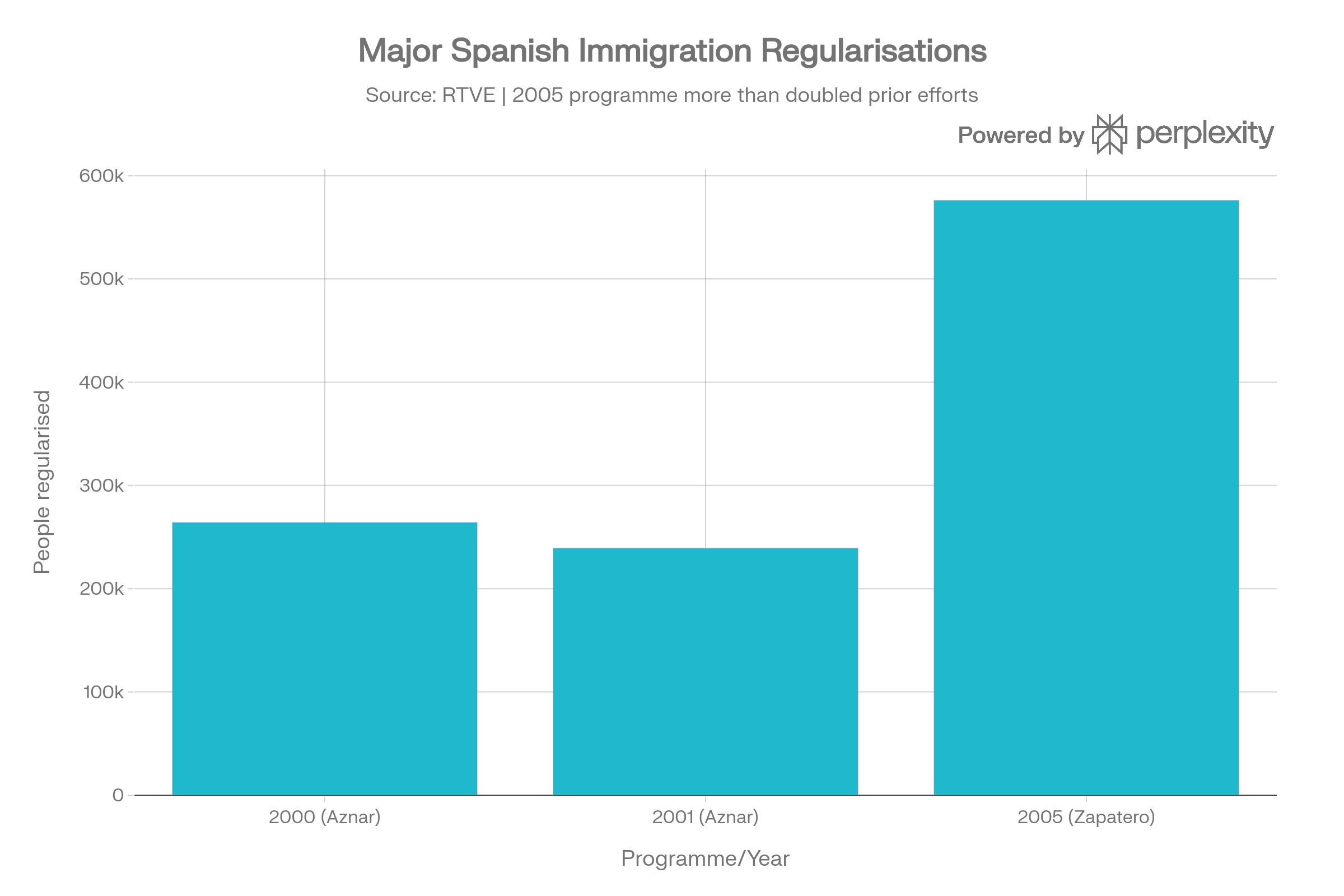
According to data cited by RTVE:
- 2005 regularisation (Zapatero): over 576,000 people regularised
- 2000 programme (Aznar): more than 264,000 people
- 2001 programme (Aznar): over 239,000 people
The government also notes that more than 40 regularisation processes have taken place across the EU since the 1990s, underlining that Spain’s approach is not exceptional by European standards.
Political debate and criticism
The measure has strong backing from civil society organisations, trade unions, and left-of-centre parties. It builds on a citizens’ legislative initiative supported by more than 700,000 signatures and a broad majority in Congress, which had been stalled for months.
The Catholic Church and numerous social organisations have welcomed the move, framing it as recognition of people who already live, work, and contribute to Spanish society.
Opposition criticism
- The Partido Popular (PP) has criticised the timing and the use of a Real Decreto, arguing it bypasses parliamentary scrutiny.
- Vox has announced a legal challenge before the Supreme Court and called for the “immediate suspension” of the regularisation.
Vox leaders argue that the measure:
- Encourages an “efecto llamada” (pull factor)
- Overburdens public services
- Threatens national identity
They have also claimed it represents a “substitution of the census.” It is important to clarify that this regularisation does not grant Spanish nationality, nor does it provide voting rights in national or regional elections.
The government’s position is that these individuals are already in Spain, often working informally, and that regularisation reduces exploitation, improves tax and Social Security compliance, and provides legal certainty for employers.
Planning your move to Spain? Check out our complete Moving to Spain guide, learn about the Non-Lucrative Visa, explore the cost of living in Spain, and discover your Digital Nomad Visa options.
Spain Immigration Regularisation: Practical Takeaways
For most US and UK nationals who move to Spain using standard visas (non-lucrative, digital nomad, student, or former golden visa routes), this extraordinary regularisation will not usually be the primary pathway, as it is designed for people already in irregular situations.
However, it is particularly relevant for:
- Non-EU family members or partners who may have fallen out of status
- Community members who have lived in Spain without residence for more than five months before 31 December 2025 and can prove it
- Employers seeking to regularise workers currently in the shadow economy
What potential applicants should do now
- Start gathering all available proof of presence in Spain before 31 December 2025
- Review criminal record requirements and begin obtaining certificates if needed
- Monitor official updates from the Ministerio de Inclusión, Seguridad Social y Migraciones, including the forthcoming Real Decreto and official Q&A guidance
Disclaimer
This article is for general information purposes only and does not constitute legal, immigration, or tax advice. It is based on publicly available information at the time of writing and may change as regulations are finalised. Readers should always verify current requirements with official Spanish authorities or consult a qualified immigration lawyer for advice tailored to their specific situation.
Get your free step-by-step Spain move plan
10 emails over 2 weeks covering visas, budget, housing & the mistakes to avoid.
Join 10,000+ expats who used this roadmap.
100% free · No credit card · Unsubscribe anytime